Account Suspended Amazon: How to Secure a Fast Reinstatement
The email hits your inbox: "Your Amazon.com selling privileges have been removed." Your heart sinks, your stomach drops, and pure panic takes over. Business stops. Revenue flatlines.
The first impulse is to mash the "Appeal" button and fire off a frantic, emotional message. Don't. This is the single biggest mistake you can make, and it guarantees your first appeal will be rejected.
Your First 24 Hours After an Amazon Suspension
When Amazon suspends you, they're sending a clear signal: something is fundamentally broken in your operation. They don't want apologies or excuses. They want a cold, logical Plan of Action (POA) that proves you've identified the root cause and implemented a permanent fix.
Rushing this process is why so many sellers get stuck in a loop of rejected appeals. The first 24 hours aren't for writing. They're for stabilizing your operation, diagnosing the real problem, and gathering intelligence.
Acting with speed over precision is a fatal mistake. Your first response sets the stage for everything that follows. A weak, rushed appeal makes every subsequent attempt exponentially harder.
Do Not Appeal Immediately
I’ll say it again: resist the urge to appeal right away. The Seller Performance team is evaluating your business competence, not your feelings. A desperate, half-baked appeal just tells them you don't grasp the gravity of the situation or have the operational control they demand from sellers.
So, take a breath. Treat this like the critical business problem it is, not a personal crisis.
Amazon’s initial suspension notices are often frustratingly vague. That’s by design. It's your job to play detective and figure out what really happened. You can’t do that in a panic.
"The quality of your appeal is directly proportional to the quality of your initial investigation. Rushing to submit anything is worse than submitting nothing at all. Amazon rewards methodical problem-solvers, not panicked sellers."
This initial period is about building a solid case for your reinstatement. The infographic below lays out the simple, three-step process you must follow before you even think about writing your POA.
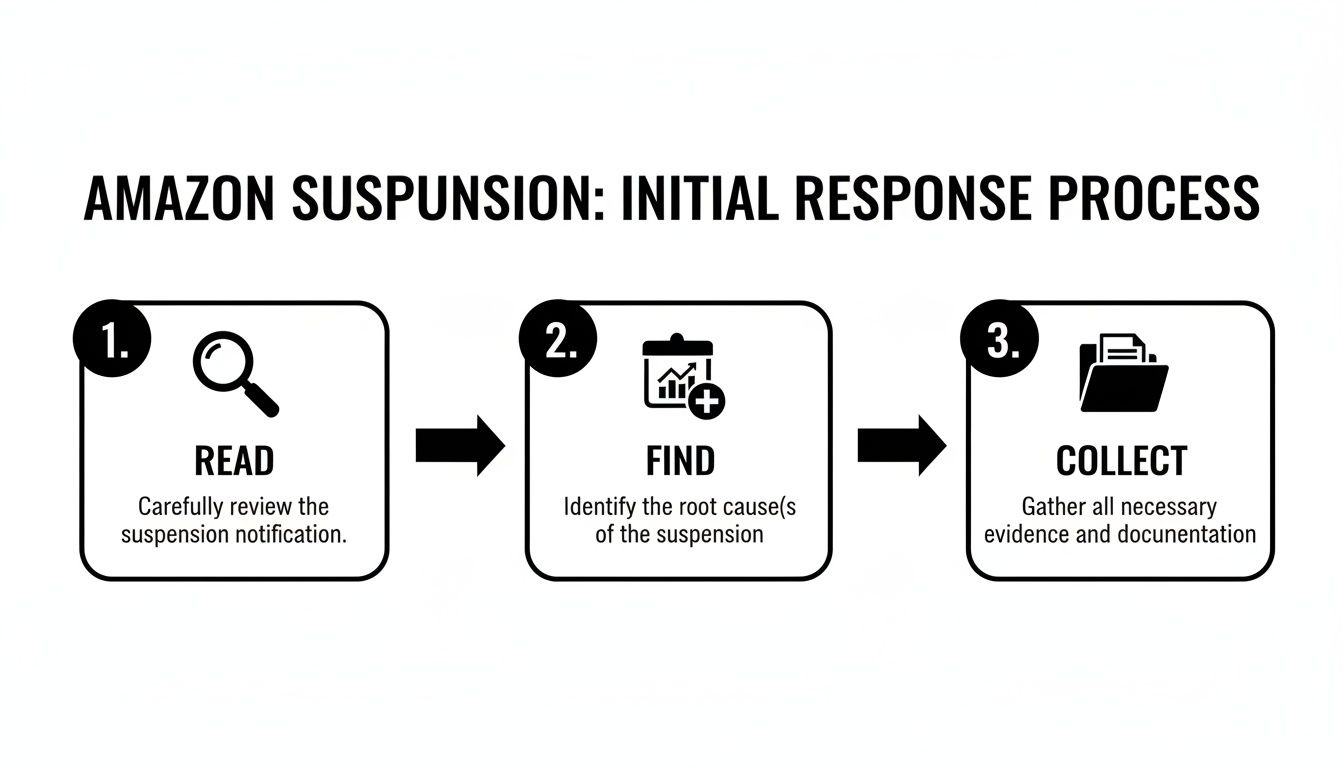
This workflow isn't just a suggestion; it's a battle-tested sequence. Read the notice carefully, find the corresponding red flags in your account, and then gather every piece of relevant documentation.
Finding the Core Violation
Your first real mission is to pinpoint the exact reason for the suspension. Amazon won't spell it out for you. You need to dig into your own Seller Central account and find the truth.
Start by going straight to these two places:
- Performance Notifications: This is ground zero. Read every single notification you received around the suspension date. Look for specific ASINs, complaint IDs, or policy warnings that came right before the final axe fell.
- Account Health Dashboard: This is where you'll find the hard data. Scrutinize every metric—Order Defect Rate (ODR), Late Shipment Rate (LSR), and any policy compliance issues. Click into each one to see the specific orders or complaints that are dragging you down.
By cross-referencing the suspension email with the data from your dashboard, you can turn a generic "account suspended" notice into a specific, actionable diagnosis. This is the only way to build a POA that actually works.
Diagnosing the True Root Cause of Your Suspension
Your Plan of Action (POA) lives or dies by one thing: your diagnosis. If you get the root cause wrong, you will fail. It’s that simple. Amazon doesn’t care about apologies. They want to see that you’ve dissected your own business, found the operational breakdown, and can prove it won’t happen again.
Simply repeating the policy you violated isn't a root cause. That’s a symptom. You need to go deeper. This means a full-blown internal audit—scrutinizing your listings, your supplier paperwork, customer feedback, everything. You have to take complete ownership, even if a supplier messed up or it feels unfair. To Amazon, you’re the captain of the ship. Period.
From Vague Notices to Specific Failures
Amazon's suspension notices are vague by design. An email about "inauthentic" products rarely means you’re peddling fakes. It usually means your paperwork—your invoices, your supply chain documentation—failed to convince them. That distinction is everything.
A classic example is using retail arbitrage receipts instead of proper wholesale invoices. This became a massive problem, triggering a huge wave of suspensions. We saw countless sellers deactivated because their sourcing documents from major retailers were flatly rejected. Amazon’s systems got stricter, and suddenly, those receipts weren't good enough. You can read the full research about these Amazon suspension causes to see just how much the landscape has changed.
Your job is to translate Amazon's generic reason into a specific, internal failure.
Amazon Says: High Order Defect Rate (ODR).
The Real Reason: Your packing team used cheap bubble mailers for a fragile item, causing a spike in damaged-in-transit complaints and A-to-z claims.
Amazon Says: Intellectual Property (IP) Complaint.
The Real Reason: Your copywriter used a competitor's trademarked phrase in the bullet points, and your quality control process never caught it.
The Internal Audit Checklist
Don't even think about writing your POA until you've done a serious internal review. Your Account Health dashboard is where you start. It’s not just a page with red and green marks; it's a map pointing to exactly what broke.

This dashboard gives you the raw data to see trends and identify the problem ASINs that pushed you over the edge.
From there, you need to ask some hard questions about how you operate.
Supplier Vetting: Did we actually vet our suppliers? Do we have legitimate invoices for every single flagged ASIN? And do they meet Amazon's non-negotiable criteria—dated within 365 days, matching business info, and showing purchase quantities?
Listing Creation: Who builds our listings? Is there a documented process to screen for IP issues, inaccurate claims, or policy-violating images before anything goes live? Or are we just winging it?
Inventory Management: How are we handling stock? Could we have sent the wrong product to FBA? Are expired items getting mixed in? Is our warehouse system a mess?
Customer Feedback: What are customers actually saying? Dig into your Voice of the Customer dashboard, read every review, and analyze seller feedback. Look for patterns—repeated complaints about damage, missing parts, or products not matching the description.
Answering these questions with brutal honesty is the only way forward. Amazon investigators have seen thousands of POAs. They can spot blame-shifting and flimsy excuses from a mile away. Admitting a systemic failure is painful, but showing you’ve built a better system is how you get reinstated.
Finding the root cause isn't about the one order that pushed your ODR past 1%. It’s about the broken shipping process that made that bad order—and all the others like it—inevitable. That's the problem you have to solve.
How to Write a Plan of Action That Actually Works
Let’s be clear: your Plan of Action (POA) is not an apology. It’s a business document. Its only job is to convince a skeptical investigator you’re a competent seller who has found and permanently fixed a systemic problem.
Emotion, excuses, and long-winded stories are your enemy here. Clarity, ownership, and precision are your only allies.
The Seller Performance team sees hundreds of these every single day. They have zero time for fluff. A winning POA has a rigid, three-part structure that cuts straight to the point. If you deviate from this format, you’re practically asking for a rejection.

Think like an investigator who has three minutes to decide your fate. Your job is to make their job easy.
The Root Cause: What Actually Went Wrong
This is where most sellers fail. They just repeat the violation back to Amazon, which proves nothing. You have to pinpoint the specific, internal process that caused the violation. It’s all about showing you understand the “why” behind the “what.”
Take complete ownership. Even if your supplier sent you junk, the root cause is your failure to have a quality control process. Blaming anyone else—customers, competitors, even Amazon—is an instant appeal killer.
Weak Root Cause:
"Our Order Defect Rate went above 1% because of A-to-z claims."
Strong Root Cause:
"The root cause of our ODR exceeding 1% was a failure in our pre-shipment quality control for ASIN [ASIN]. This led to 12 units with manufacturing defects being shipped, resulting in 7 A-to-z claims for 'product not as described' between [Date] and [Date]."
See the difference? The second one is specific, uses data, and shows a real understanding of the operational breakdown.
Immediate Corrective Actions: What You Did Right Now
This section lists the concrete steps you’ve already taken to fix the immediate issue. This isn’t about what you will do; it’s about what’s already done. Use the past tense.
Your goal is to show Amazon you’ve stopped the bleeding. A simple bulleted list works best.
- Inventory Review: "We have physically inspected all remaining FBA and FBM inventory for ASIN [ASIN] and removed all units with the identified defect."
- Listing Deactivation: "The listing for ASIN [ASIN] was immediately closed to prevent further sales."
- Customer Resolution: "We have proactively contacted and fully refunded all 12 customers who reported issues with the defective units."
These actions show you're taking this seriously and protecting the customer experience above all else.
"Your POA is a reflection of your operational discipline. A vague, unstructured appeal signals a chaotic business. A clear, logical, and evidence-based POA proves you have the systems required to operate successfully on their platform."
Long-Term Preventive Measures: How You'll Stop It from Happening Again
This is the most important part of your POA. Amazon needs to believe that this specific failure is now impossible. You have to outline the new systems, processes, and checks you’ve put in place that directly address the root cause.
Get specific about the changes to your standard operating procedures (SOPs).
Weak Preventive Measure:
"We will check products more carefully."
Strong Preventive Measure:
"We have implemented a new, mandatory three-point quality control inspection for all inbound supplier shipments. This process, documented in our new QC manual (attached), includes:
- Component Check: Verifying [specific component] is present and correctly assembled on 10% of all units.
- Functionality Test: Powering on and testing 5 sample units from every master carton.
- Packaging Audit: Ensuring all units are in new, protective polybags with the correct FNSKU label. Any shipment failing inspection is rejected and returned to the supplier."
When you're outlining these preventative steps, think about improving your overall ecommerce customer experience. A solid operational plan shows you're not just fixing one mistake but are strengthening your entire business to better serve Amazon's customers. That's what they really care about.
Your new systems must be so airtight that a repeat offense is structurally impossible. This is how you rebuild trust and get that account suspended amazon notice reversed.
Assembling the Right Evidence to Support Your Appeal
A killer Plan of Action is only half the battle. Without concrete proof to back up every single claim, your POA is just empty words to an Amazon investigator. This is where you stop telling them you've fixed the problem and start showing them.
Think of it this way: Amazon's team needs to tick boxes. Your job is to hand them every document they need, formatted perfectly, so they can tick those boxes without a second thought. Any missing invoice or blurry screenshot gives them an easy out to deny your appeal and move on to the next case in their queue.
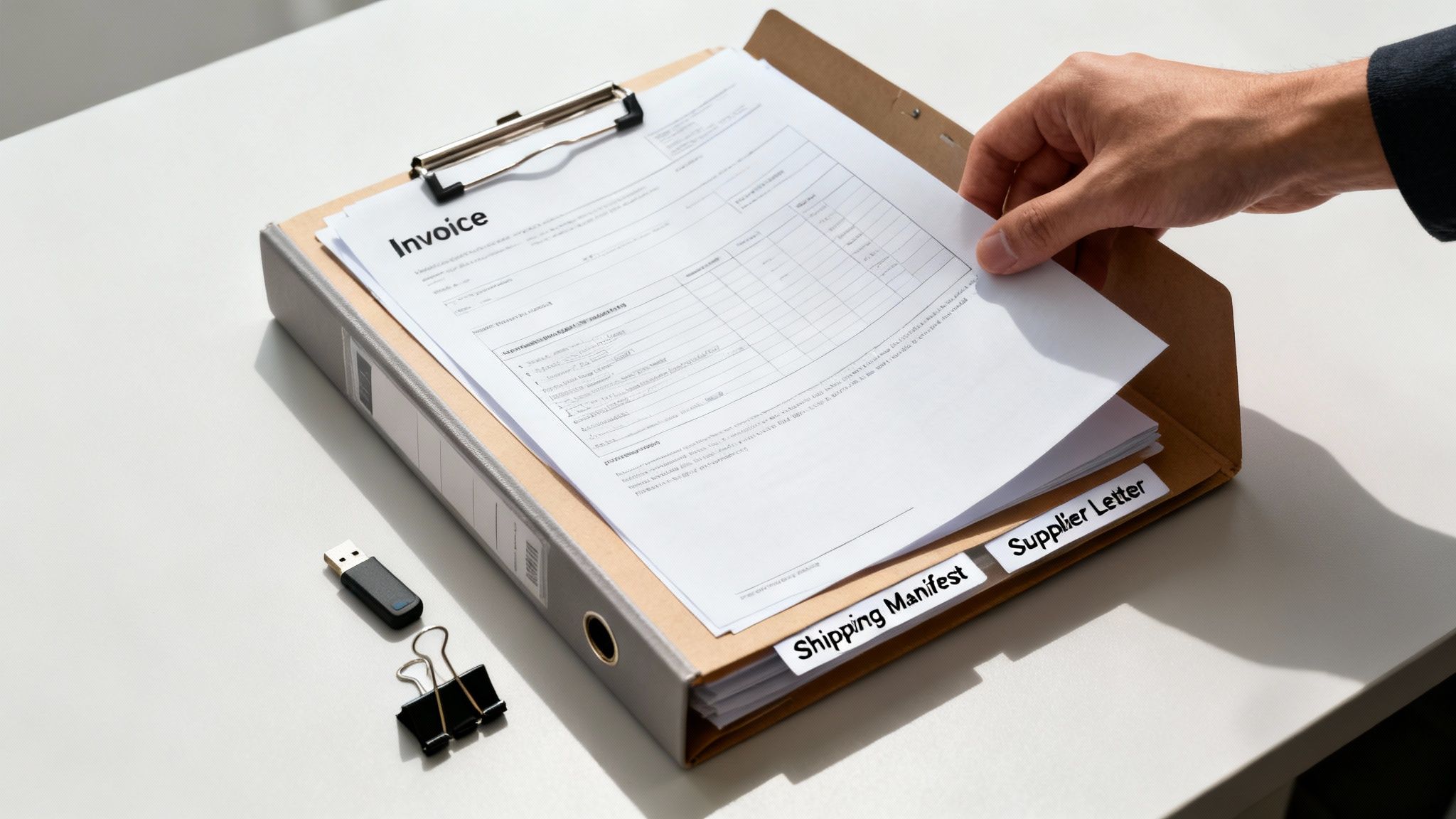
Don't just dump a folder of documents on them. This is about precision. You need to match the evidence directly to the suspension reason.
Match Your Evidence to the Violation
Every suspension type has its own "evidence checklist." Sending shipping manifests for a copyright complaint is a waste of everyone's time and instantly shows you don't grasp the core issue.
Here’s a quick rundown:
Inauthenticity or Counterfeit Claims: This is purely a supply chain issue. You'll need flawless supplier invoices. A Letter of Authorization (LOA) from the brand owner is even better. Forget about retail receipts—they're worthless here.
Performance Issues (ODR, LSR): Now we're talking logistics and customer service. Proof could include carrier shipping manifests, delivery confirmations for orders that buyers claimed never arrived, or even screenshots of your polite and prompt messages to customers.
IP or Copyright Infringement: Here, you have to prove you have the legal right to sell the item. An LOA from the brand or rights holder is the gold standard. Invoices from an authorized distributor are your next best bet.
Sometimes, the suspension is about you, not your products. For flags related to identity, Amazon might put your business under a microscope. Being familiar with thorough identity verification processes helps you anticipate their requests for business licenses, utility bills, and IDs that match your Seller Central info to the letter.
To make this crystal clear, here’s a breakdown of what Amazon is looking for based on why you were suspended.
Amazon Suspension Triggers and Required Evidence
This table shows the most common reasons for suspension and the exact documents you'll need to gather. Pay close attention to the common mistakes—they're the fastest way to get your appeal rejected.
| Suspension Type | Primary Evidence Required | Common Seller Mistake |
|---|---|---|
| Inauthenticity/Counterfeit | Supplier invoices dated within 365 days; Letter of Authorization (LOA) from the brand. | Submitting retail receipts, proforma invoices, or order confirmations instead of final invoices. |
| High Order Defect Rate (ODR) | Proof of delivery for disputed orders; screenshots of customer communication; shipping manifests. | Only addressing the symptoms in the POA without providing documents showing improved processes. |
| Intellectual Property (IP) Violation | LOA from the rights holder; invoices from an authorized distributor; retraction notice from the complainant. | Arguing "fair use" or ignorance; providing invoices from an unauthorized liquidator. |
| Used Sold as New | Invoices showing new condition purchase; photos of your quality control process; customer communication records. | Blaming FBA for warehouse damage without showing proof of your own QA checks before shipment. |
| Account Verification/Related Accounts | Utility bills and business licenses matching Seller Central info exactly; proof of account closure for old accounts. | Submitting documents with slight name/address mismatches; using a PO Box address. |
Getting this part right is non-negotiable. An investigator won't dig for the truth; you have to present it to them on a silver platter.
The Anatomy of an Acceptable Invoice
When your account suspended amazon email mentions authenticity, your invoices are everything. They have to be perfect. Both automated bots and human reviewers scan them for very specific details.
Your invoices must:
- Be dated within the last 365 days.
- Show your full business name and address, matching your Seller Central profile exactly.
- Include your supplier's full name, address, phone number, and website.
- Clearly list itemized quantities for the ASINs under review.
- Be in their original, unaltered format. PDF is best. Never redact pricing.
I see this all the time: sellers submit a proforma invoice, a shipping document, or a simple order confirmation email. These are not proof you actually bought the inventory. Amazon will reject them instantly. You need the final, paid invoice from your supplier.
How to Format Your Submission
Presentation matters more than you think. Reviewers are under pressure and flying through cases. Make their job easy.
Smart File Naming: Name your files logically.
Invoice_ASIN-B0123ABC_Supplier-XYZ.pdfis infinitely better thanscan_001.pdf.Highlight Key Info: Before you upload, open the PDF and use a highlighter tool. Mark your business info, the supplier's details, the date, and the specific ASINs. Guide the reviewer's eyes right to what they need to see.
Keep It Lean: Only attach what was asked for. If you have multiple invoices for one ASIN, combine them into a single PDF. Don't bury your crucial evidence in a pile of irrelevant documents.
Once you’ve attached your evidence and your POA in Seller Central, take a breath. The waiting game begins. Don't flood them with follow-ups. Trust the work you've done.
What to Do When Your Amazon Appeal Gets Rejected
Getting that rejection notice after you’ve poured hours into your appeal is a punch to the gut. It’s a hard stop that tells you one thing: your Plan of Action (POA) didn’t work.
But it's not the end. Think of it as a data point. The rejection is Amazon telling you that you either missed the root cause or your evidence wasn't strong enough. This is your cue to pause and rethink your approach, not just change a few words and resubmit.
Digging Into the Rejection
A rejected appeal forces you to get brutally honest with yourself. Did your POA genuinely take responsibility, or did you find a way to blame the customer or Amazon? Were your preventive steps concrete and specific, or just a vague promise to "be more careful"?
Most of the time, the problem is in the root cause analysis. You probably addressed the symptom—the metric that went into the red—but you failed to fix the broken internal process that caused it in the first place. This is where you have to dig deep.
Should You Revise or Escalate?
After your first rejection, the answer is almost always to revise your POA.
Jumping straight to an escalation is a bad look. It tells Amazon you're impatient and aren't taking their feedback seriously. Use the rejection as a signal to go back to the drawing board, find the real root cause, and gather much stronger evidence.
Escalation is your last resort. It’s for when you've submitted multiple, significantly different appeals and are getting nowhere, or if you're 100% certain a mistake has been made on Amazon's end. When you do escalate, don't just paste your old POA. Write a new, concise summary of the original suspension, what you’ve done to fix it, and a direct request for a senior investigator to review your case.
The goal isn’t just to get back online; it’s to make sure this never, ever happens again. The most successful sellers I know take the lessons from a suspension and build a stronger, more resilient business because of it.
Shifting from Reactive to Proactive
Getting reinstated is just the beginning. The real work starts now: making your business bulletproof against future suspensions. This means you have to stop putting out fires and start building firewalls.
Too many sellers completely ignore their Account Health dashboard until it’s a full-blown emergency. This is a massive mistake. Thousands of sellers get suspended when their Order Defect Rate (ODR) creeps over 1% or their late shipment rate goes past 4%. These weren't sudden events. They were the predictable result of ignoring mounting A-to-Z claims and negative feedback until Amazon cut off their access. You can read more expert analysis on why these specific metrics are so dangerous.
You need to implement a strict account health checklist. This isn't a suggestion—it's a non-negotiable for long-term survival.
Daily Checks (5 minutes is all it takes):
- Quickly scan your Performance Notifications for any new warnings.
- Glance at your Account Health dashboard. Are any metrics trending yellow?
- Check new feedback and reviews for any recurring complaints.
Weekly Deep Dive (30 minutes):
- Go into your Voice of the Customer (VOC) dashboard. See any patterns?
- Audit your shipping metrics. Is a specific carrier letting you down?
- File away new supplier invoices so they're ready if you ever need them.
Monthly Audit (1 hour):
- Do a full review of your top 5 ASINs. Read every recent review and make sure the listing is still compliant with Amazon’s latest rules.
- Read Amazon's policy update emails and adjust your processes immediately.
This kind of discipline turns your Account Health dashboard from something you dread into one of your most valuable business tools. It lets you catch problems while they’re small, long before they ever put your account at risk.
Amazon Suspension FAQs: Straight Answers to Tough Questions
When you get that suspension email, your mind starts racing, and the internet is full of bad advice. Let's cut through the noise. Here are direct answers to the most common questions I hear from sellers, based on years of getting accounts back online.
How Long Does It Take to Get an Amazon Account Reinstated?
Honestly? Anyone giving you a specific number of days is just guessing. There's no standard timeline.
I’ve seen simple, well-documented appeals get a reinstatement in 24-48 hours. But I've also seen complex cases involving intellectual property or related accounts drag on for weeks, even months.
It really boils down to three things:
- The Violation: A slip-up on performance metrics is a much quicker fix than a counterfeit claim.
- Your First Appeal: A sharp, well-supported Plan of Action that nails the root cause on the first try is your fastest path back. Vague appeals create a soul-crushing back-and-forth that adds weeks to the process.
- Amazon's Workload: During Q4 or after a big policy change, Seller Performance gets slammed. Everyone's wait time goes up.
The hardest part is being patient. Spamming them with new tickets won't speed things up—in fact, it can bump you to the back of the line.
Should I Pay for an Amazon Appeal Service?
The classic "it depends" answer applies here. It really comes down to the complexity of your case and your confidence in writing a professional business document.
For straightforward issues—like a high Order Defect Rate—you can often handle it yourself. If you can clearly pinpoint your mistake and describe the new systems you've put in place to fix it, you probably don't need to hire help.
But for the big, messy suspensions, an experienced consultant can be a lifesaver. Think about hiring a pro if you're facing:
- Intellectual Property (IP) or counterfeit complaints.
- The dreaded "related account" suspension.
- Repeat suspensions for the same issue.
- Multiple rejected appeals.
A huge red flag is any service that guarantees reinstatement. Nobody can promise a 100% success rate. Reputable experts sell experience, not magic. They should always review your case before you pay them a dime.
Can I Just Open a New Seller Account?
No. Absolutely not. Do not even think about it.
Trying to open a new account to sidestep a suspension is one of the worst things you can do. It's a cardinal sin in Amazon's rulebook.
Amazon's ability to link accounts is scarily sophisticated. They see everything: bank info, addresses, IP addresses, company details, even the devices you log in from. When they catch you, they'll permanently ban both accounts, and your chance of ever selling on Amazon again drops to near zero.
This isn't a theoretical risk. It happens all the time. The only way forward after that account suspended amazon notice is to fight for your original account.
What Happens to My Money and FBA Inventory?
The moment you're suspended, Amazon locks everything down to protect customers.
Your funds are immediately frozen. They'll hold your money for at least 90 days to cover any potential A-to-z claims or refunds. If your appeal works, your funds are usually released in the next payment cycle. If it's denied, that hold can last much longer.
Your FBA inventory is stranded. It sits in the fulfillment center, but it’s completely un-sellable. If you get reinstated, it becomes active again. If you're permanently banned, Amazon gives you a short window to create a removal order and get your inventory back (on your own dime).
The financial pressure is real. This is why getting your first appeal right is so critical—it gets your business, your cash, and your products moving again.
Ready to prevent suspensions by ensuring your product listings convert better and have fewer customer complaints? ProductShots creates research-driven Amazon listing images that address buyer concerns before they become problems, improving your metrics and protecting your account. Get your complete, optimized image set at https://prodshots-hadzm8fa.manus.space.