Amazon Account Suspension: A Strategic Guide to Fast Reinstatement
An Amazon suspension notice hits like a gut punch. Your listings vanish, revenue halts, and the impulse to panic is immediate.
Your first instinct is to fire off a reply—to apologize, argue, or just do something. Stop. A rushed, emotional response is the single biggest mistake sellers make, turning a solvable problem into a permanent ban.
The first 24 hours are for cold, strategic analysis, not frantic action.
Your First Moves After an Amazon Suspension Notice
Your only job is to dissect that suspension notice with surgical precision. This is not about what you think went wrong; it's about what Amazon is explicitly telling you.
Deconstruct the Notification
Amazon’s language is often vague, but every word is deliberate. You must identify the exact suspension category, as it dictates your entire appeal strategy.
- Performance-Based Suspension: This is about metrics. The notice will cite your "Order Defect Rate," "Late Shipment Rate," or "Pre-fulfillment Cancel Rate." These are data-driven problems, and your appeal must be equally data-driven.
- Policy Violation Suspension: This is more severe. You broke a specific rule. Keywords to look for are "Section 3," "Code of Conduct," or "Intellectual Property complaint." These suspensions require proof of systemic operational changes.
- Authenticity Complaints: If the notice mentions "inauthentic" or "counterfeit," stop everything. This is a red-alert violation. Your entire focus must shift to your supply chain, backed by bulletproof documentation.
Pinpoint the Specific ASINs
Amazon rarely suspends an account without referencing specific products. Locate the ASINs or SKUs in the email or on your Account Health Dashboard.
These products are ground zero. Your investigation and all gathered evidence must revolve around these items. Do not get sidetracked by the rest of your catalog.
Your first appeal is your best, and often only, real shot at reinstatement. If you waste it with a generic, poorly researched response, your chances of success plummet. A methodical, evidence-based approach is non-negotiable from hour one.
These suspensions are often sudden. A major 2020 study on European markets found that 23% of German third-party sellers had their accounts suspended that year. More telling, 66% received no warning before being shut down.
This is why a disciplined response plan is critical. You can review the findings in the study about Amazon's enforcement actions.
Immediate Triage Checklist for a Suspended Account
Once you know the what (violation) and the where (ASINs), begin assembling evidence. Do not write a single word of your appeal yet.
This checklist turns panic into productive action and builds the foundation for a solid Plan of Action. Approaching Amazon without this documentation is like showing up to court with no evidence.
| Action Item | Rationale & Key Focus |
|---|---|
| Halt All FBM Shipments | Immediately stop shipping self-fulfilled orders. New metric defects will complicate your case. |
| Download Performance Reports | Pull everything from your Account Health Dashboard. Focus on ODR, VTR, and customer feedback related to the violation. |
| Compile Invoices for Flagged ASINs | Gather complete, unaltered supplier invoices from the last 365 days. They must show supplier details and your business information. |
| Verify Supplier Information | Collect your supplier’s contact information—name, phone number, address, and website. Amazon may verify it. |
| Isolate Relevant Customer Feedback | Find all negative feedback, A-to-z claims, and buyer messages connected to the flagged ASINs. The root cause is often here. |
| Review All Listing Content | Scrutinize the title, bullets, description, and images of the flagged ASINs for policy violations or inaccuracies. |
With this file, you are no longer reacting. You are preparing to build an appeal that actually works.
Diagnosing the True Root Cause of Your Suspension
Amazon's suspension notice is the symptom, not the disease.
Their formal, infuriatingly vague language tells you which policy you broke, but it rarely explains how or why. A successful reinstatement hinges on connecting their accusation to a specific, tangible breakdown in your operations.
Your Plan of Action (POA) will be rejected if it just parrots Amazon’s words. You must conduct an honest, unflinching internal audit to find the real root cause. This is not about excuses; it is about identifying a systemic failure that requires a permanent fix.
This framework moves you from panic to productive analysis.
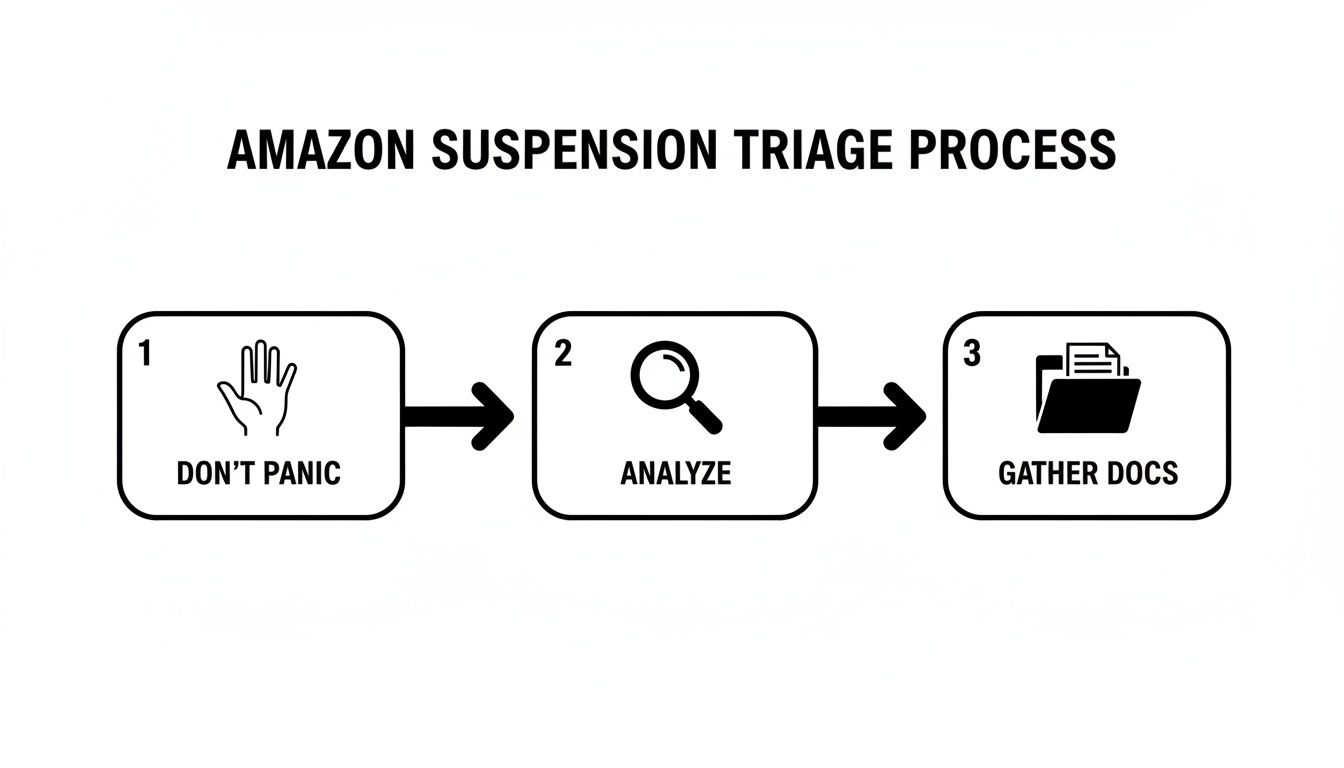
Don't Panic, Analyze, and Gather Docs. This is the foundation of every successful appeal. It forces you to act from a position of evidence, not emotion.
Section 3 and Code of Conduct Violations
A "Section 3" violation is Amazon's catch-all for serious misconduct. It means they believe you've done something fundamentally wrong, from review manipulation and operating multiple accounts to selling counterfeit goods. Your investigation must be broad and deep.
- Multiple Accounts: Do you have any ties to another seller account? Think old business partners, family members using the same WiFi, or a third-party service with user permissions. Amazon's ability to link accounts is sophisticated and frequently catches sellers by surprise.
- Review Manipulation: Have you ever used a service to get reviews? Offered rebates or free products for feedback? Amazon has zero tolerance, and the connection may be less direct than you think.
- Unfair Practices: Are you using aggressive tactics like keyword stuffing to divert traffic? Or making false claims about competitors? This falls under prohibited seller activities and is a common trigger for a Section 3 takedown.
Intellectual Property (IP) and Inauthenticity Claims
These are two of the most common and dangerous suspension triggers. Sellers often confuse them, but they are not the same, and your POA must address the correct one.
An IP complaint is a legal claim from a rights owner. They believe you've infringed on their trademark (using their brand name), copyright (using their photos or text), or patent. Your job is to investigate the claim's validity. Did you use "Kleenex" in your generic tissue listing's title? Did you lift images from the brand’s website? That's IP infringement.
An inauthenticity claim is a question about your product's origin and supply chain integrity. A customer might complain, "this feels fake," or Amazon’s bots might flag something. Here, your documentation—invoices, not retail receipts—is your only defense.
The most critical mistake sellers make is treating an inauthenticity claim like a simple misunderstanding. To Amazon, it’s a fundamental breach of trust. Your POA must prove your supply chain is now airtight against unverified goods.
Inauthenticity remains a leading cause of suspensions, with weak sourcing paperwork as the primary culprit. Sellers buying from retailers like Walmart and attempting to resell with receipts get shredded by Amazon's systems. You can learn more about how sourcing documentation impacts suspensions.
Dropshipping Policy Breaches
Amazon’s dropshipping policy is specific, and violations are an easy way to get suspended. The rules are clear: you must be the seller of record on all invoices and packing slips, and you must handle customer returns yourself.
If a dropshipping violation triggered your suspension, your root cause analysis must answer these questions:
- Did you buy products from another online retailer (e.g., Home Depot) and have them ship directly to the customer? This is a textbook violation.
- Did your supplier's branding appear on the packing slip? Also a violation, as it identifies a third-party shipper.
- Were you unable to fulfill orders because your supplier ran out of stock? This increases your pre-fulfillment cancellation rate, a performance metric that triggers a policy suspension.
Finding the true root cause means taking ownership. It’s the moment you stop blaming Amazon’s vague notice and start dissecting your own business processes. Only then can you build a POA that solves the problem Amazon actually cares about.
How to Write a Plan of Action That Actually Works
Let's be clear. Your Plan of Action (POA) is not an apology letter. It is not a place to plead your case or complain about unfairness.
It is a formal business document. Its sole purpose is to prove, clinically and professionally, that you have identified a systemic failure, corrected it, and implemented safeguards to prevent its recurrence.
Most sellers fail here. They write emotional, rambling essays that get an instant rejection. The Seller Performance team consists of risk managers, not counselors. They need a clear, logical, evidence-backed case.
Your POA requires military precision. Use this battle-tested, three-part framework that answers the only questions Amazon’s investigators care about.

Part 1: The Root Cause Analysis
This is the most critical section, where most appeals fail. Do not simply repeat the violation Amazon cited. You must demonstrate a deep, internal investigation that uncovered the specific operational breakdown causing the violation.
Weakness here is fatal.
"We received an inauthenticity complaint" is useless. A strong root cause sounds like this: "The root cause of the inauthenticity complaint on ASIN B00XXXXXXX was our failure to properly vet a new supplier, [Supplier Name], and our lack of a process to obtain direct-from-manufacturer invoices before listing their products."
Your analysis must prove you understand the "why" behind the "what."
- For Performance Issues: Don't say your Late Shipment Rate was high. Explain why. Was it a software glitch in your inventory management system? Did your fulfillment team lack proper training on new packing procedures?
- For Policy Violations: Don't just admit to violating the dropshipping policy. Pinpoint the exact failure. Did a hired VA source from another retailer without your knowledge? Was your supplier agreement missing a clause forbidding third-party branding on packing slips?
Be brutally specific. Take full ownership. The problem was internal, and you have found it.
Part 2: Immediate Corrective Actions
You've diagnosed the problem. Now, explain how you stopped the bleeding. This section details the immediate, concrete steps you have already taken to fix the issue for affected customers and your account.
This is about past actions, not future promises. Use a bulleted list for clarity.
- We have contacted every customer who purchased ASIN B00XXXXXXX in the last 60 days, apologized for the issue, and issued a full refund without requiring a return.
- All remaining inventory for ASIN B00XXXXXXX has been removed from FBA via removal order ID [Order ID Number].
- We have terminated our business relationship with the unvetted supplier, [Supplier Name], and have destroyed all remaining stock sourced from them.
- A full audit of our active catalog is complete. We identified and permanently deleted 12 other ASINs sourced from unverified distributors.
These actions demonstrate responsibility and prioritize the customer experience. Including specific details, like a removal order ID, adds credibility that generic statements lack.
Part 3: Long-Term Preventative Measures
This is where you prove the problem will never happen again. You must outline the new systems, processes, and safeguards implemented across your entire operation. Amazon needs to see that you've built a suspension-proof business.
This section is your blueprint for future compliance. Be obsessively specific.
"We will be more careful" is a death sentence for a POA. You need to show Amazon the new SOPs you have built and the training you have implemented. They need to see a machine, not a promise.
Detail the new mechanics of your business. How have you fundamentally changed the way you operate? Think in terms of systems, not intentions.
Weak vs Strong POA Statements
The difference between a denied appeal and a reinstatement is the level of detail and commitment you can prove. Vague statements fail; specific, systemic changes win.
| POA Section | Weak Statement (Avoid) | Strong Statement (Use) |
|---|---|---|
| Root Cause | We made a mistake and listed a product we shouldn't have. | Our root cause was a failure in our listing creation SOP, which lacked a final IP verification step by a trained manager before an ASIN could go live. |
| Corrective Actions | We have removed the listing in question. | We have permanently deleted the infringing ASIN (B01XXXXXXX) and audited our entire catalog, removing 5 additional ASINs with potential trademark conflicts. |
| Preventative Measures | We will train our staff better on Amazon's policies. | We have implemented a new three-stage listing process: 1) Initial creation by a VA, 2) IP and policy check by a manager using [specific internal checklist], and 3) Final approval by the account owner before any ASIN is activated. All staff completed mandatory training on this new SOP on [Date]. |
Notice how the "Strong" column details actual, verifiable changes to business operations. That's what Amazon's team needs to see.
Keep your entire Plan of Action concise, professional, and scannable. Use short sentences and bullet points. The investigator has minutes, not hours. Make their job easy.
Mastering the Appeal Submission and Escalation Path
A perfect Plan of Action is useless if it gets lost in Amazon's bureaucracy. The submission and follow-up phase is not a passive waiting game; it's a strategic process demanding precision and discipline.
One wrong move can sabotage an otherwise solid appeal.
Submit your POA only through the "Reactivate Your Account" button on your Account Health page. Never email it directly to a generic address like [email protected] unless explicitly instructed to do so. That's the digital equivalent of throwing your appeal into a black hole.
Once you hit "Submit," your job is to wait. This is the hardest part.
The Danger of Impatient Follow-Ups
The urge to check in a day later is strong, but it's a critical error. Every time you send a new message or reopen the case, you push your appeal to the back of the line.
Amazon's system treats each new message as an update, resetting the internal clock on your case. Initial review can take from a few days to several weeks. Patience is non-negotiable.
A submitted appeal enters a managed queue. Chasing it with constant follow-ups doesn't show diligence—it signals panic and clogs their system. Let your single, well-crafted POA do its job without interference.
Multiple messages also appear unprofessional and desperate, which can subconsciously bias the investigator. Submit it once.
When Your First Appeal Gets Rejected
It happens. You will likely receive a generic, templated denial offering zero insight into why it was rejected. Most sellers either give up or hire expensive consultants at this point.
Before doing either, execute a clear-headed escalation strategy.
Critically re-evaluate your POA. Even a generic response contains clues. If they asked for "greater detail," your root cause analysis was too shallow or your preventative measures were too vague. You must revise and strengthen your POA before resubmitting.
The Escalation Path
If your revised POA is also denied—and you are certain you have provided a robust and complete plan—it may be time to escalate. Escalation means trying to get your case in front of a more senior team.
This is usually done by requesting that your case be forwarded to a leadership or specialist team within Seller Performance. Frame this request professionally and concisely in your next submission.
- State the facts: Briefly summarize your suspension reason, the number of appeals submitted, and why you believe your POA fixes the root cause.
- Request review by a manager: Politely ask for your case to be reviewed by a senior investigator or manager.
- Keep it brief: Your escalation request should be a short preface to your revised POA, not a long complaint.
This path requires persistence. An Amazon account suspension is a serious business problem; fixing it demands a methodical approach long after the appeal is written.
Building a Suspension-Proof Amazon Operation
Reinstatement is a reactive, painful process. The real victory is never getting suspended in the first place. Once you survive a suspension, your entire focus must shift to building an operation that is resilient to future threats.
This isn't about ticking boxes on a compliance checklist. It's about weaving risk management into the fabric of your company—seeing compliance not as a chore, but as a core business function that protects your most valuable asset.

Establish Non-Negotiable Daily Habits
A suspension-proof operation is built on consistent, daily discipline. Complacency is your biggest enemy. Treat your account health like a vital sign that needs constant monitoring.
Your day should start in the Account Health Dashboard. Make it a non-negotiable habit. That dashboard is Amazon’s direct line to you, flagging where problems are brewing.
- Read Performance Notifications: Every single one. Ignoring a small warning today is how you wake up to a major suspension tomorrow.
- Monitor Your AHR: The Account Health Rating (AHR) is your canary in the coal mine. Any dip demands immediate investigation. Don’t wait for it to turn red.
- Stay Ahead of Policy Updates: Amazon constantly changes the rules. Carve out time each week to read the "News" section in Seller Central. Pleading ignorance has never worked as a defense.
Harden Your Supply Chain and Documentation
Inauthenticity claims are account killers, and 99% of them trace back to a weak supply chain. If your sourcing documents cannot withstand scrutiny, you are operating on borrowed time.
This means getting beyond simple receipts. Amazon demands robust, traceable paperwork proving an unbroken chain of custody from the manufacturer to you.
An inauthenticity suspension isn't Amazon calling you a counterfeiter. It's Amazon saying your paperwork failed to prove you aren't. The burden of proof is entirely on you, and weak documentation is an automatic fail.
Implement a rigorous vetting process for every supplier.
- Demand Verifiable Invoices: Your invoices must be complete, unaltered, and issued before you list the product. They must show the supplier's full contact info, your business details (matching your Seller Central account), and itemized quantities consistent with your sales volume.
- Verify Supplier Legitimacy: Go beyond their website. Look for a physical address, a business registration, and real industry references. If a deal seems too good to be true, the products are likely sourced through gray-market channels that Amazon will reject.
- Maintain an Impeccable Paper Trail: Organize every invoice and communication by ASIN and date. When Amazon requests documents, you must produce them in minutes, not days.
Fortify Your Listings Against Complaints
Many suspensions are triggered by customer complaints, especially "not as described" claims. These are often self-inflicted wounds from lazy or exaggerated listing content. Your product images and copy are a contract with the customer.
When a buyer receives something that doesn't match the photos or the claims in your bullet points, you have created the ideal scenario for a complaint. These complaints accumulate as negative data points against your ASIN and, eventually, your account.
Optimizing your listing content for 100% accuracy is one of the most powerful preventative moves you can make.
- Images Must Reflect Reality: Use crisp, high-res photos that show the product from every angle. Always include a scale shot to manage size expectations. Infographics must highlight real features, not unsubstantiated claims.
- Scrub Your Copy: Read every bullet point and description as if you were a skeptical buyer. Remove subjective fluff ("highest quality") and replace it with objective facts and specifications.
- Mine Negative Reviews: Your one- and two-star reviews are a goldmine for spotting gaps between expectation and reality. If buyers repeatedly say a product is "smaller than expected," your images have failed. Fix them.
This operational discipline is critical. To understand the stakes, consider the true cost of shipping compliance violations, which extend beyond fines to include permanent damage to your reputation and account suspension. By building these systems, you shift from being a potential victim of Amazon's enforcement bots to a resilient, professional operator.
Got Questions About Amazon Suspensions? We've Got Answers.
When that suspension notice lands, your head spins with questions. Here are straight answers to the most common questions from sellers in your position.
Why Did Amazon Suspend Me Without Any Warning?
This shocks most sellers. One minute you're fine, the next you're shut down.
Amazon's prime directive is to protect the customer. For severe issues like Section 3 violations, authenticity claims, or IP complaints, they don't issue warnings. Their systems flag a potential risk to buyers, and they suspend first, ask questions later. This is precisely why proactive account health monitoring is your only real defense against a sudden shutdown.
How Long Does an Amazon Suspension Appeal Actually Take?
Anyone giving you a specific timeline is guessing. There is no magic number.
A simple case with clear evidence might be resolved in 48-72 hours. But complex situations involving related accounts or major policy violations could take weeks, or even months. The single biggest factor impacting reinstatement speed is the quality of your first Plan of Action. Do not spam them with follow-ups—that just pushes you to the back of the line.
Key Takeaway: A single, well-researched Plan of Action is infinitely better than five rushed, incomplete ones. In this game, patience isn't just a virtue; it's a strategy.
Can't I Just Open a New Seller Account?
Let me be blunt: absolutely not.
Trying to open a new account after a suspension is the fastest way to a lifetime ban. Amazon's ability to link accounts is sophisticated, using everything from bank info and addresses to IP addresses and user permissions. Do not even consider it. The only path forward is to fix the root cause of the original suspension and get that account reinstated. Any other move is a dead end.
At ProductShots, we build research-backed Amazon listing images that not only boost conversions but are also fully compliant with Amazon's ever-changing rules. This helps reduce the kind of listing-related complaints that can put your account at risk. Learn more and get your optimized images today.