The Amazon Appeal Process: Your Path to Reinstatement
The suspension email from Amazon is a gut punch. It’s a feeling every seller dreads, and what you do in the first 24 hours dictates whether you get reinstated quickly or stuck in a soul-crushing loop of appeals.
Panic is your worst enemy. It leads to rushed, emotional replies that Amazon’s bots are programmed to reject instantly. Stop. Breathe. Think strategically.
My Account is Suspended. What Now?
First, understand that the notification email is intentionally vague. It’s a template designed to make you do the investigative work.
Resist the urge to immediately write back explaining how unfair this is. This is the single biggest mistake sellers make, and it almost guarantees your first appeal will be rejected. Amazon’s performance team does not care about your frustration or your claims of innocence.
Treat this as a cold, hard business problem. The system that flagged your account is procedural, and it demands a procedural, fact-based response. Your goal is not to argue. It is to demonstrate to Amazon that you understand the risk they believe you pose to their customers and that you have implemented permanent fixes.
Find the Real Root Cause
Before you can draft a Plan of Action (POA), you must become a forensic investigator. The suspension notice is just a breadcrumb; the real evidence is buried in your account. Do not guess.
Read the Performance Notification. Again. Read it three times. Is the violation about intellectual property (IP)? Inauthentic claims? A sky-high Order Defect Rate (ODR)? Each requires a completely different approach and different evidence.
Dive Into Your Account Health Dashboard. This is ground zero. Scrutinize every metric, especially under Policy Compliance. Look for the specific ASINs that triggered warnings or complaints. The answer is usually there.
Check "Voice of the Customer" (VOC). This is a goldmine. The VOC page reveals the exact customer feedback that likely triggered the automated flag. Look for patterns—are buyers repeatedly claiming the item arrived broken, wasn't as described, or seemed fake? This often points directly to a disconnect between your listing images and the actual product experience.
This deep dive helps you find the true root cause. It’s rarely a single bad order; it’s usually a crack in your process. For sellers, mastering the appeal process is the first critical step to getting back online and figuring out how to improve e-commerce sales.
Key Takeaway: Stop everything and analyze. Firing off a quick appeal is the fastest way to get a final "no." Amazon rewards sellers who are methodical and prove they've done their homework. Often, the root cause is a visual one—your images created an expectation the product couldn't meet. This is a strategic failure, not just a customer service issue.
Decoding the Suspension and Gathering Your Evidence
The Amazon appeal process is not a negotiation. It's a stone-cold audit where you present hard proof that you’ve found—and fixed—a hole in your operations. Rushing this stage with assumptions is the number one reason appeals are rejected.
Your first stop is the Account Health dashboard. Drill down into the specific ASINs that triggered the violation. Amazon’s system is almost always set off by a specific product complaint. Look for patterns in your Voice of the Customer (VOC) feedback. Are customers complaining that a product is "not as described" or "used sold as new"? These are breadcrumbs leading straight to the root cause, and often, that cause is a misleading or incomplete set of product images.
The Evidence Checklist
Your goal is not to prove Amazon wrong. It's to prove you've found the internal weakness that allowed the problem to happen. This requires a solid file of evidence that backs up the story you're about to tell in your Plan of Action (POA).
- Supplier Invoices: Must be legitimate, unaltered, and dated within the last 365 days. They need full supplier contact info and quantities that align with your sales volume.
- Letters of Authorization (LOA): For IP or authenticity claims, an LOA from the brand owner is non-negotiable. It's the only proof that you're an authorized reseller.
- Internal Quality Control (QC) Documents: How do you check inventory? Show them. Provide checklists, photos of your QC process, or SOPs that prove you have a system for catching defects. If the complaints are visual ("smaller than expected"), your QC process should include photographic verification against your listing images.
- Customer Communications: Dig up messages related to the complaints. These provide context and show you were proactive before Amazon stepped in.
The point of this exercise is to connect the dots. You must link a specific customer complaint on a specific ASIN directly to a failure in your operations. A complaint about a broken seal might point to a sloppy FBA prep process. A complaint that a product is "cheap plastic" when your images make it look like brushed metal is a failure in visual communication—your images sold a promise the product couldn't keep.
The modern Amazon appeal process is less about a human conversation and more about satisfying an algorithm. Success hinges on how you structure your evidence. Professional appeal services often see success rates as high as 98% because they craft a POA that ticks the right boxes. They identify the true operational failure, which is often rooted in how the product was presented visually.
Building Your Case File
Get organized. For every ASIN under review, create a dedicated folder with all related documents. It's tedious but critical.
In some cases, your suspension might be tangled up with payment issues or chargebacks. If so, you absolutely need to consult payment processing experts to get the right documentation.
The decision-making process has to be methodical: stop everything, dive deep into the data, and only then start writing your response.
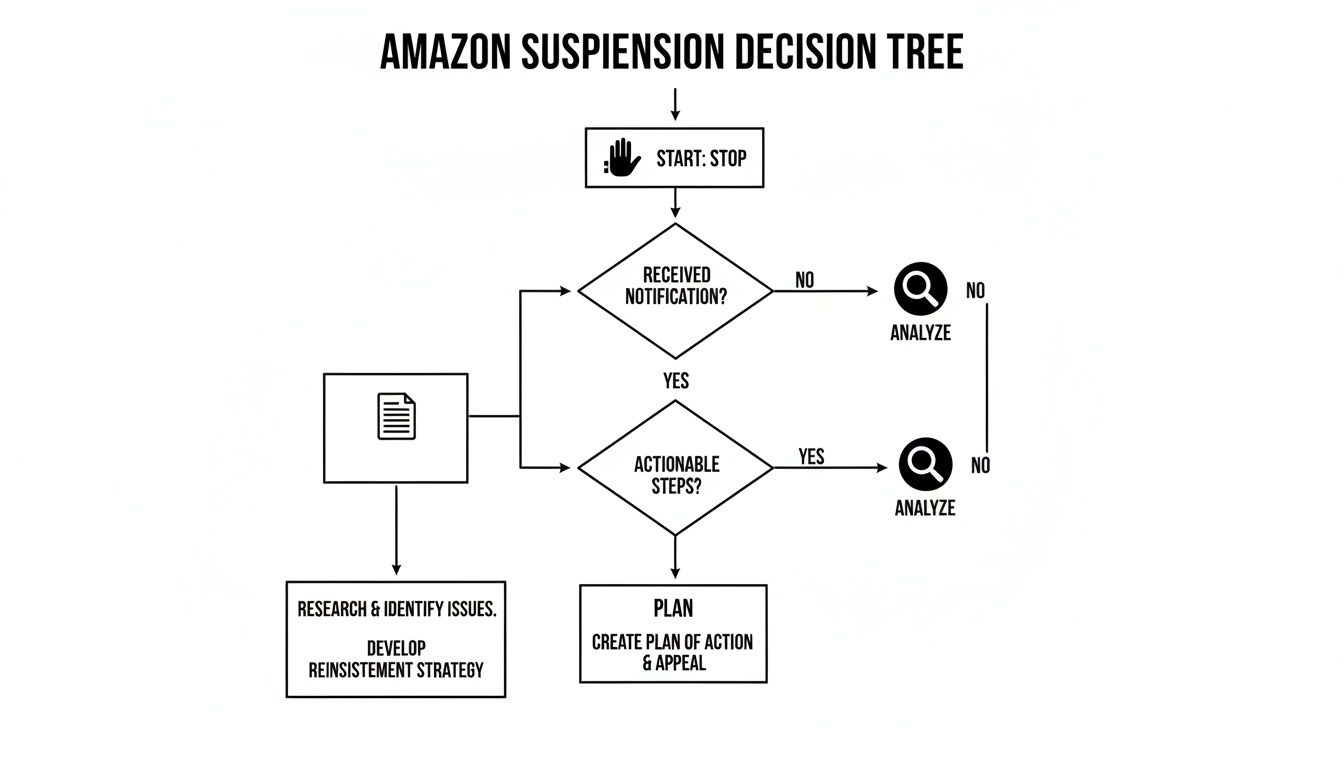
This flowchart drives home the importance of the analysis phase. If you misdiagnose the root cause, any plan you write is pure guesswork, and Amazon will reject it flat out.
Remember, every piece of evidence must support the central theme of your appeal: you found the root cause—be it logistical or visual—and you implemented a permanent fix. To learn more about our strategic approach to Amazon visuals, you can review our work here: https://prodshots-hadzm8fa.manus.space.
Writing a Plan of Action That Amazon Will Actually Read
Your Plan of Action (POA) is the single most important document in this process. A generic, templated POA is a complete waste of time. It will be rejected. Amazon investigators see thousands of these and can spot a lazy, copy-paste job from a mile away.
This is not the place for excuses or emotional appeals. Think of your POA as a technical business document. Its only job is to convince a risk-averse corporation that you've identified, solved, and future-proofed against a specific operational failure.
The document must be structured perfectly, with three non-negotiable sections.

Section 1: The Root Cause
This is where most sellers fail. They blame the customer, Amazon, or a competitor. Or, they offer a surface-level cause like "a customer complained." Both are recipes for instant rejection.
You must dig into your own processes to find the systemic breakdown that allowed the problem to occur.
- Weak Root Cause: "A customer complained the item was smaller than expected."
- Strong Root Cause: "Our product listing for ASIN XXXXXX failed to accurately manage customer expectations. Our lifestyle images did not adequately convey the product's scale, and we lacked a dedicated scale-comparison graphic. This visual misrepresentation led to customer complaints of 'not as described' and a high return rate, which we failed to address proactively."
The strong example takes total ownership and pinpoints a specific failure in visual marketing and operational oversight. It shows Amazon you've done the real work.
Key Takeaway: You must accept 100% responsibility, even if you believe you are not at fault. The Amazon appeal process is not a court of law; it’s a business risk assessment. Arguing your innocence is the fastest way to get permanently banned.
Section 2: Immediate Corrective Actions
Detail the concrete steps you have already taken to fix the problem for any affected customers. This is damage control.
This section must be in the past tense. It’s what you have done, not what you will do.
- Weak Corrective Action: "We will update our listing."
- Strong Corrective Action: "We immediately initiated a removal order for all 147 units of ASIN XXXXX from FBA to prevent further customer issues. We have already processed full refunds for the 3 customers who reported issues (Order IDs: #1, #2, #3). The product listing has been made inactive pending a complete overhaul of its image gallery."
Specificity is your best friend. Use exact numbers, order IDs, and ASINs. Completed actions are proof you're serious.
Section 3: Long-Term Preventative Measures
This is the most critical part of your POA. This is where you prove to Amazon that this specific problem can never happen again.
Think bigger than "trying harder." We're talking about new processes, training, and operational standards.
- Weak Preventative Measure: "We will take better pictures."
- Strong Preventative Measure:
- We have implemented a mandatory 'Visual Accuracy SOP' for all new and existing listings. This requires every product to have at least one infographic with precise dimensions and one in-context lifestyle photo that clearly demonstrates scale.
- Our marketing manager, [Manager's Name], is now responsible for reviewing all listing images against customer feedback from the 'Voice of the Customer' dashboard on a bi-weekly basis to proactively identify and correct potential expectation gaps.
- All new product photography will now be audited against the top three customer complaints for the product category to ensure we address common objections visually before launch.
The stronger example outlines a new, permanent system with clear accountability. It’s a structural change to your business. This is what convinces Amazon that you're now a lower-risk seller.
Plan of Action Do's and Don'ts
| POA Section | Ineffective Approach (Don't Do This) | Effective Approach (Do This Instead) |
|---|---|---|
| Root Cause | Blaming customers or Amazon. Giving vague reasons like "mistakes were made." | Taking 100% ownership. Pinpointing the specific breakdown in your internal process (e.g., visual marketing) that allowed the issue. |
| Corrective Actions | Making future promises. Being general about the problem's scope. | Describing actions already completed (past tense). Using exact numbers, ASINs, and Order IDs. |
| Preventative Measures | Promising to "be more careful." | Detailing new, permanent systems, tools, or staff responsibilities that make a recurrence impossible. |
Finally, formatting is as important as content. Use short paragraphs, bullet points, and bold key info. A dense wall of text will get skimmed and likely rejected. Your tone should be clinical, factual, and completely free of emotion. Stick to the facts, own the problem, and present the solution.
Submitting Your Appeal and Managing the Waiting Game
You’ve done the hard work. Your Plan of Action is sharp, your evidence is organized, and you’re ready to submit. But this final step—and the brutal waiting game that follows—is where many sellers drop the ball.
Think of this as a legal filing, not a customer service ticket. Every document needs to be perfectly formatted, clearly labeled, and referenced directly in your POA.
To submit, go to Seller Central and find Account Health under the Performance tab. Locate the policy violation, click the Appeal button, and upload your documents. Use PDF for everything. Name your files logically (e.g., "Invoice-ASIN-XXXXX-Supplier-XYZ.pdf"). Triple-check that everything is attached before you submit.

Setting Realistic Expectations for a Response
Once you hit submit, the discipline begins. The Amazon appeal process is not what it used to be.
Amazon's official timeline is often quoted as 24 to 72 hours. This is now a fantasy. The process has become a black box, with bots handling the first pass far more often than a person. You can find valuable insights on MyAmazonGuy.com that dig deeper into the current state of these timelines.
Your first response will likely be a canned rejection asking for more information. This is not a final "no." It's an automated flag telling you that your POA missed a key point the algorithm was looking for. Your job is to decode their vague language, find the weak spot, and send back a much stronger appeal.
Why Patience Is a Non-Negotiable Strategy
The absolute worst thing you can do while you wait is to spam Seller Performance. Opening new cases or sending follow-up emails for an "update" doesn't help. It actively hurts your case.
This behavior flags your account for "appeal fatigue." Amazon's system is built to push sellers who clog the queue to the back of the line. Do it enough, and they might even impose a 30-day cooldown period where they won't review any more submissions from you.
Treat this like a chess match. Your first submission is your opening move. If it gets rejected, you don’t just play the same move again. You go back, analyze the board, strengthen your position, and then make your next move.
The silence from Amazon feels personal, but it’s just an overloaded machine. Your ability to stay patient and strategic is what separates a successful reinstatement from a permanent ban. If you’re stuck or need a second opinion on your case, feel free to contact our team for a consultation.
When and How to Escalate a Failed Appeal
Getting a rejection on a Plan of Action you poured hours into is a gut punch. But if you’ve sent in a solid appeal only to get a generic, templated denial, it might be time to escalate.
Escalation is not spamming the same POA to a new email address. Think of it as a calculated, final attempt to get human eyes on a case that the automated system cannot solve.
This is your last resort, not your first move. You should only escalate after at least two or three carefully revised appeals have been rejected through the normal Seller Central process. Each rejection should have pushed you to make your POA significantly stronger.
Revising Your Strategy for a Higher Level Review
When you escalate, you're writing for a senior team member, possibly from the Executive Seller Relations team, who can overturn the original decision. Your entire approach must change.
The escalated POA needs to be surgically precise. Distill your original three-part plan down to its most powerful, undeniable points.
- Lead with an executive summary. Start with one paragraph stating the suspension reason, the ASINs involved, and a clear declaration that you've identified and permanently fixed the root cause.
- Be hyper-factual. Cut all fluff. Use bullet points to lay out the root cause, immediate actions, and preventative measures in the most direct language possible. If the issue was visual, state how your new images directly solve the previous problem.
- Attach overwhelming proof. Your evidence file must be airtight. If the problem was inauthenticity, your file needs pristine invoices, a letter of authorization, and photos of your QC process. If it was "not as described," include before-and-after screenshots of your image gallery, highlighting the new, clearer visuals.
This is not a plea for mercy. It's a clinical presentation of facts that makes reinstating your account the only logical business decision.
Your escalation is a business case, not a sob story. Frame your argument around risk mitigation. You must prove that your new systems—including your new standards for visual accuracy—make you one of the safest, most reliable sellers on the platform. Show them you protect their customers and their brand reputation.
The Rationale Behind a Clinical Approach
Amazon’s internal processes are built on a history of legal battles. Their number one directive is to eliminate risk to their customers.
This mindset was hardened by cases like the 2016-2017 FTC settlement over unauthorized in-app charges, which cost the company over $70 million in refunds. You can read more about the FTC's findings on the settlement to understand their risk-averse culture.
This history is why emotional appeals fall flat. Amazon’s legal and executive teams are trained to respond to documented processes and irrefutable proof, not stories about how unfair the situation is. Your escalation must show you understand this and have aligned your business with their worldview.
Channels for Escalation
Direct emails to executive teams are less effective than they used to be. The most well-known is the [email protected] email, monitored by the Executive Seller Relations team.
When using this channel, keep your email incredibly brief. It should be a cover letter for your condensed POA and evidence file. The only goal is to get them to open your attachments.
If you want more background on our strategic approach to these kinds of e-commerce challenges, you can learn more about our company and its philosophy.
Amazon Appeal Process FAQs
An Amazon suspension is one of the most stressful events a seller can face. Your revenue grinds to a halt, and the path forward is rarely clear. Let’s cut through the noise and answer the most pressing questions.
How Long Should I Wait Before Sending Another Appeal?
Do not send anything until Amazon responds. Period.
Sending multiple appeals for the same issue clogs their system and can flag your account for "appeal fatigue," leading to automatic rejections. You are not being proactive; you are making it harder for them to say yes.
If they reject your appeal, the clock resets. Take the time you need—a day, a week—to understand why your last Plan of Action (POA) failed and to write a significantly better one.
Blunt Truth: Every rushed follow-up digs your hole deeper. Amazon tracks your appeal history. Repeated failures make it exponentially harder to get reinstated. Make every submission count.
Should I Admit Fault if I Think Amazon Is Wrong?
Yes. Unconditionally.
The Amazon appeal process is not a courtroom. You are there to convince a risk-management team that you are a responsible business partner who will not cause future problems.
Arguing or blaming buyers is the fastest way to get your account shut down permanently. Their process is designed to filter for sellers who take ownership. Your POA must accept full responsibility. Even if a competitor sabotaged you, your job is to find the flaw in your process that allowed it to happen. Often, this flaw lies in how your product is presented—your images may have unintentionally created a vulnerability.
Is It Worth Hiring an Amazon Appeal Service?
For complex issues—IP claims, related accounts, or high-stakes velocity reviews—hiring a professional is a smart investment. The cost is almost always less than the sales lost during weeks of failed DIY appeals.
These services understand the unwritten rules. They know how to diagnose the real root cause (which often differs from the suspension notice) and write a POA in the clinical format Amazon investigators are trained to approve.
If you go this route, vet them carefully. Look for a track record specifically in account reinstatements and ask for case studies related to your exact suspension type.
What if Amazon Stops Responding to My Emails?
The "we may no longer respond" message feels final. It isn't always. This is Amazon's filter to stop sellers from spamming them with the same rejected POA.
At this point, you have one last shot. Go completely silent for at least 60 days. Use that time to build an overwhelmingly compelling new case. This cannot be a minor edit; it requires new evidence and a fundamentally different approach, often involving a complete overhaul of the problematic ASIN's listing images and marketing strategy.
This is also the point where you might consider formal arbitration, as outlined in your seller agreement. It is an expensive, complex legal process and an absolute last resort.
A suspension feels like a disaster, but it is a solvable problem. Success requires a methodical, evidence-based approach that puts clear communication and real operational fixes—especially to your visual assets—first.
Many suspensions stem from customer complaints like "not as described" or "inauthentic," which are often symptoms of weak listing images that create false expectations. Investing in strategic, high-converting product photography is not just about sales; it's a critical defensive measure that prevents the very issues that put your account at risk.