Why Your Amazon Images Are Sabotaging Your PPC Campaigns
You’re burning cash on Amazon PPC. Your ACOS is climbing, your click-through rate is flat, and you’re convinced the problem is your keyword strategy or bidding.
You’re wrong.
The single biggest lever you can pull to improve PPC performance isn't in your ad console—it’s in your product listing images. For established Amazon sellers, optimizing images is no longer a “nice to have.” It is the most critical defense against wasted ad spend and the most direct path to profitable scale. Images sell first; copy sells second. A PPC campaign built on weak, unoptimized creative is doomed from the start.
This guide isn’t about basic photography. It’s a strategic breakdown of how to audit your listing images through the lens of buyer psychology and conversion, turning them from a passive asset into your most powerful sales weapon.
The Real Job of Your Amazon Images: Drive Conversion

Stop thinking of your images as simple product photos. They are a multi-stage sales funnel compressed into a seven-slot carousel. Each image has a specific job: grab attention, build desire, overcome objections, and drive the click. If any image fails its mission, you lose the sale and your PPC click was wasted.
An image audit is a forensic analysis of this visual sales pitch. It identifies where your images are failing to convert shoppers and provides a clear, actionable roadmap to fix the leaks. This isn't about subjective beauty; it's a data-driven process rooted in conversion rate optimization (CRO).
Your Images Are a PPC Force Multiplier
Every dollar you spend on Amazon Ads drives traffic to your listing. But what happens after the click? The conversion is won or lost in the first three seconds a shopper spends scanning your images.
- Higher CTR (Click-Through Rate): Your main image is your ad creative. In a crowded search results page, a compelling, clear, and benefit-driven main image earns the click over competitors, even if you aren’t in the top ad slot. A weak main image makes your PPC spend invisible.
- Higher CVR (Conversion Rate): Once on the listing, your secondary images must immediately answer the shopper’s questions, demonstrate value, and build trust. Better images lead directly to higher unit session percentages, which tells Amazon your product is a winner.
- Improved ACOS/ROAS: This is simple math. When your CVR improves, your Advertising Cost of Sale (ACOS) decreases and your Return on Ad Spend (ROAS) increases. You make more sales for the same ad spend. Optimizing images is the fastest way to make your PPC budget more efficient.
- Increased Price Tolerance: Strategic images that effectively communicate premium quality, unique features, and solve painful problems allow you to command a higher price. Customers will pay more when they perceive more value, and that perception is built almost entirely through visuals.
Your images are not a separate function from your advertising. They are the engine that determines whether your ad spend returns a profit or goes up in flames.
Core Components of a Strategic Image Audit
A professional image audit dissects your visual strategy layer by layer. It moves beyond "does it look good?" to "does it sell?"
| Audit Area | Common Mistakes Uncovered | Strategic Benefit |
|---|---|---|
| Main Image | Not filling the frame, busy backgrounds, no clear value proposition, fails the "glance test" on mobile. | Immediately increases CTR from search results and Sponsored Product ads, lowering your CPC. |
| Image Carousel Flow | Random order, no clear narrative, repeats information, fails to build a persuasive argument for buying. | Guides the shopper on a deliberate journey from interest to purchase, systematically overcoming objections. |
| Infographics & Text Overlays | Too much text, low-contrast fonts, feature-listing instead of benefit-selling, not mobile-optimized. | Conveys critical selling points quickly and effectively, reducing shopper hesitation and increasing add-to-carts. |
| Lifestyle & Use-Case Images | Generic stock photos, unbelievable scenarios, fails to connect with the target audience's aspirations or problems. | Creates an emotional connection, helps the shopper visualize the product in their life, and justifies the purchase. |
| Comparison & Objection Handling | Ignoring competitor weaknesses, failing to address negative review themes, not providing clear differentiators. | Proactively answers the shopper's biggest doubts, neutralizes competitor advantages, and builds critical trust. |
| Brand Story & Social Proof | Lacking brand presence, not using customer testimonials or UGC-style images to build credibility. | Elevates the product from a commodity to a trusted brand solution, fostering loyalty and justifying a premium price. |
This isn't a checklist. It's a strategic framework for deconstructing your visual sales pitch and rebuilding it for maximum conversion.
An image audit’s real value isn't in finding what's ugly; it's in creating a precise, data-backed plan to build a more resilient and profitable product listing.
The process is methodical. An auditor scrutinizes your entire image stack against competitor offerings, customer reviews (yours and theirs), and established principles of buyer psychology to build a winning game plan.
The Critical Role of Audits in Scaling Your Brand
Running an Amazon brand without regularly auditing your images is like flying blind. You're losing conversions, wasting ad spend, and letting competitors with better visual strategy steal your market share.
A real image audit isn't a simple creative review. It’s a deep diagnostic for any brand serious about growth on the Amazon platform. It’s not about finding fault; it’s about building a high-performance conversion asset that scales.
The Defensive Strategy: Stop Leaking Conversions
First, an image audit plays defense. Its primary job is to plug the invisible leaks in your conversion funnel that silently drain your ad budget and kill your profitability.
An audit targets the common visual mistakes that plague even established listings.
- Unclear Main Image: If your main image doesn’t immediately communicate what the product is and why it's valuable within one second on a mobile screen, you lose the click. Your ad impression was wasted.
- Ignoring Buyer Objections: Your negative reviews are a goldmine. Are shoppers confused about size? Worried about durability? An audit identifies these themes and ensures your images address them head-on.
- Feature-Dumping Infographics: Listing product specs is not selling. An audit reframes those features into clear, compelling benefits that solve a customer’s problem. "5mm thick steel" is a feature. "Won't bend or break, guaranteed" is a benefit.
The Offensive Strategy: Engineer a Higher Conversion Rate
Plugging leaks is only half the battle. A great image audit is an offensive weapon designed to proactively engineer a higher conversion rate. It shifts your mindset from just showing the product to strategically selling it.
This is where a research-driven, outside perspective pays for itself.
An audit isn't just about fixing mistakes. It’s about reallocating your visual real estate to high-impact selling points. You turn a defensive move into a powerful offensive play for market share.
An offensive audit systematically looks for opportunities your competitors have missed. It provides a clear map to visual dominance.
Finding Untapped Pockets of Profit
A thorough audit gives you a strategic roadmap to scale. On Amazon, visual real estate is everything.
Consider this: a shopper is far more likely to scan all seven of your images than to read your bullet points or description. Untapped image slots or weak infographics represent a massive missed opportunity. An expert audit identifies these gaps and turns them into conversion drivers.
The offensive side of an image audit focuses on a few key areas:
- Benefit-Led Storytelling: Crafting a visual narrative across your image carousel that guides the shopper from problem to solution.
- Competitor Teardowns: Analyzing top competitors' images to identify their weaknesses and create visuals that explicitly highlight your superior features.
- Review Mining for Gold: Turning common themes from 5-star reviews into powerful social proof infographics.
- Mobile-First Design: Ensuring every image is perfectly legible and impactful on a small screen, where the majority of purchases happen.
Ultimately, an image audit delivers a one-two punch. It protects your current ad investment by killing conversion leaks while building a blueprint for smart, profitable growth.
Inside a Professional Image Audit Process
So, what actually happens during a real image audit? It’s not a subjective creative critique. It’s a methodical investigation, moving from a 30,000-foot view of your market position down to the pixel-level details of a font choice on an infographic.
Think of it as reverse-engineering a perfect sale. The goal is to systematically uncover where your visual presentation is causing friction and pinpoint exactly where the biggest opportunities for conversion uplift are hiding.
It all starts with research. Before a single image is analyzed, a good auditor dives into your product, your competitors, and most importantly, your customer reviews. What are the main purchase drivers? What are the deal-breaking objections? This research phase is everything—it ensures every recommendation is tied back to real buyer psychology, not just design trends.
The Four Pillars of a Conversion-Focused Image Audit
A proper audit isn't a random spot-check. It's a structured teardown of the four critical pillars that hold up any high-converting Amazon listing.
| Pillar | Key Checks | Impact on Performance |
|---|---|---|
| Clarity & Comprehension | Can a shopper understand the product's purpose and key benefit in 3 seconds? Is the main image clear and compelling? | Without instant clarity, you lose the click-through from search and the initial interest on the product page. |
| Benefit & Value Proposition | Do the images sell a solution or just show a product? Is the value obvious? Do infographics translate features into benefits? | This is where desire is built. Weak value communication leads to price comparisons and abandoned carts. |
| Trust & Objection Handling | Do the images address common concerns from negative reviews? Do they use social proof? Do they look professional and credible? | Trust is the foundation of ecommerce. Failing to address objections proactively kills conversion. |
| Differentiation & Branding | Why should a customer buy from you? Do the images clearly show your unique selling proposition (USP) vs. competitors? | Weak differentiation turns your product into a commodity, forcing you to compete on price alone. |
Each pillar builds on the last. You can’t build trust if the shopper doesn’t even understand what you’re selling. It's a full-stack analysis of your visual sales pitch.
Checking the Foundation: The Quick Wins
The first deep-dive is about clarity and mobile optimization. This is where we find the "low-hanging fruit"—the easy fixes that can boost CTR and conversion almost overnight.
We’re looking for obvious red flags:
- Weak Main Image: Does it comply with ToS while maximizing frame space? Is it instantly recognizable? This is the single most important image you have.
- Mobile Illegibility: Are text-heavy infographics unreadable on a phone? This is a classic, costly mistake that renders your key selling points useless to a majority of shoppers.
- Lack of a Visual Hierarchy: Is the image carousel a random jumble of photos? A disorganized set of images confuses the shopper and breaks the selling narrative.
Dissecting What You're Actually Communicating
With the foundation secured, the audit moves into the heart of your listing: the messaging within your infographics and lifestyle photos. This is where the real detective work happens, scrutinizing your visual language and looking for disconnects between what you think you're communicating and what the customer actually perceives.
An auditor will comb through your images asking: Are you showing a feature, or are you demonstrating a benefit? Are your lifestyle photos aspirational and relatable, or do they look like generic stock images?
This part is critical. A set of images that simply shows the product from six different angles is one of the biggest, most common sources of low conversion rates. It's a silent killer of your PPC ROI.
From Click to Conversion: The Final Mile
Getting the click is only half the battle. If the shopper’s journey through your images falls apart, the click was worthless. This is the final pillar of a rigorous audit.
We evaluate your entire image carousel as a single, persuasive argument. Does it tell a story? Does it systematically overcome the most likely objections? For many Amazon brands, just reordering their existing images into a more logical flow can deliver huge wins. For more on that, the AZ prodshots blog is packed with insights on conversion-focused creative.
A great audit connects every single dot, from the shopper's initial search query to the moment they feel confident enough to hit "add to cart." It's a holistic review that understands a PPC click is only valuable if the post-click visual experience is seamless and persuasive.
This entire process is designed to move your visual strategy from defense to offense, and ultimately, to scalable growth.
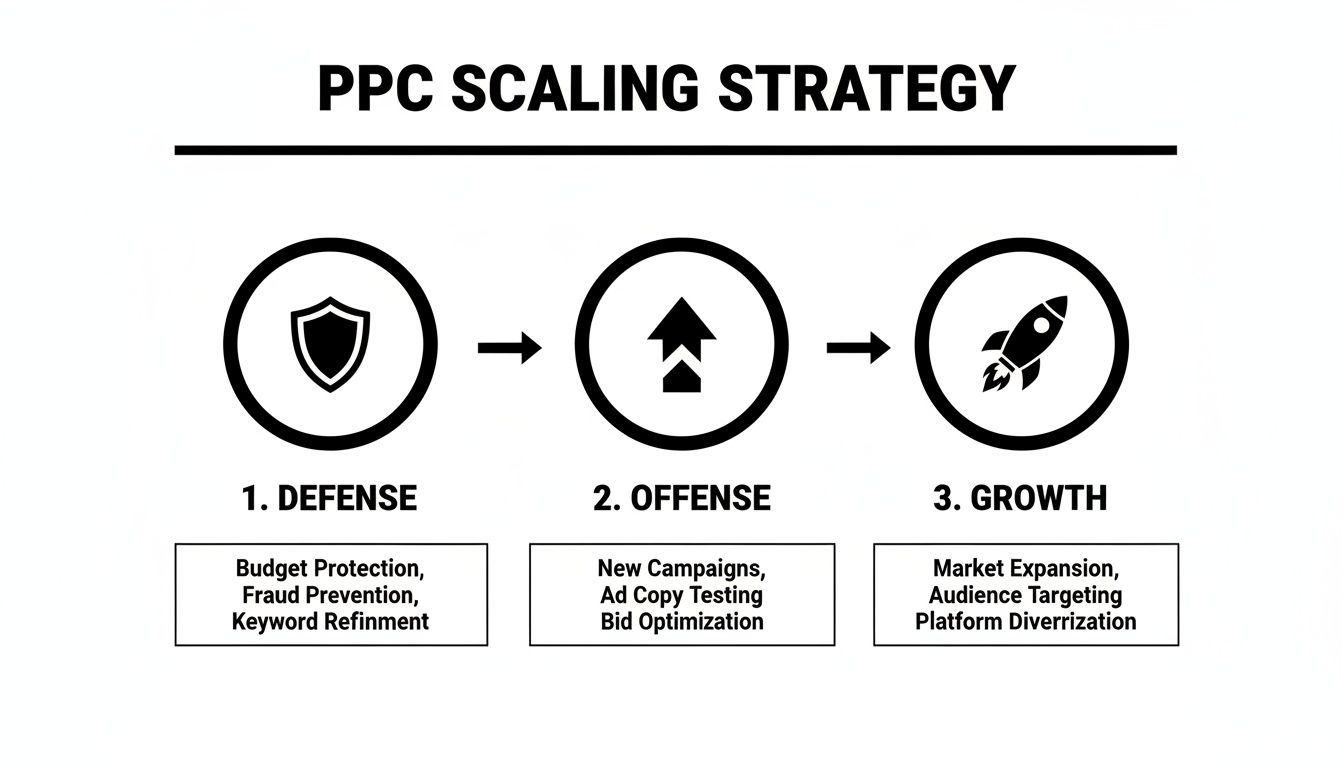
As you can see, you have to start by defending your budget against waste caused by poor conversion. Only then can you go on the offensive with a high-performing asset and finally enter a growth phase to scale what’s working.
The audit wraps up with a clear action plan, not a 100-page design critique. A professional image audit will give you a prioritized list of what to fix now versus what to build for the long term. You should walk away knowing exactly what to do next.
The Key Metrics That Reveal Image Performance
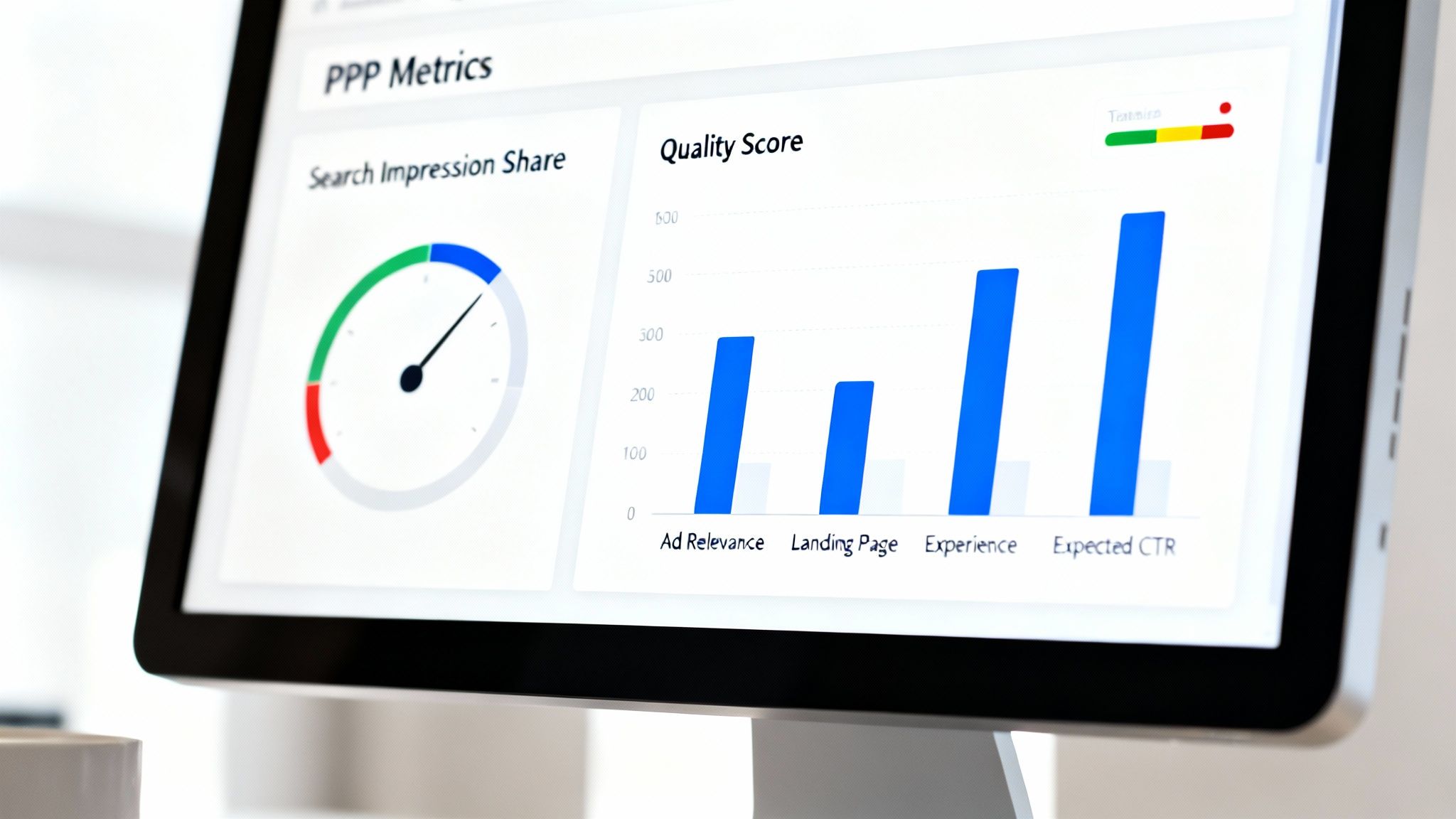
Forget vanity metrics. To understand the true impact of your images, you have to look at the business KPIs they directly influence. There is no "Image Score" in Seller Central. The performance of your images is reflected in your core business metrics.
A real image audit connects the dots between your creative assets and your P&L. It focuses on the diagnostic KPIs that expose the true health—or sickness—of your listing's conversion power. These are the numbers that tell a story, revealing not just what happened, but why.
Unit Session Percentage: The Ultimate Report Card
This is it. The single most important metric for evaluating the overall effectiveness of your product listing. Unit Session Percentage (found in your Business Reports) is your conversion rate. It tells you what percentage of sessions to your page resulted in a sale.
Your images are the primary driver of this metric.
A low or declining Unit Session Percentage is a giant flashing red light that your listing is failing to convert traffic. While copy, price, and reviews play a role, the visual presentation is the first and most impactful element a shopper engages with. If your images don't sell, this number will suffer, and no amount of PPC spend can fix it.
An audit uses this metric as the ultimate benchmark. The goal of every image recommendation is to directly and measurably increase your Unit Session Percentage.
Click-Through Rate (CTR): The Gateway Metric
Your Click-Through Rate on Sponsored Product and Sponsored Brand ads is a direct reflection of your main image's performance. When a shopper sees your product in the search results, they have three pieces of information: your main image, your title, and your price/reviews. The image is what does the heavy lifting.
A low CTR, especially when your ad placement is good, indicates a main image problem.
- Is it eye-catching? Does it stand out from the sea of competitors?
- Is it clear? Can the shopper tell what the product is in a split second?
- Does it communicate value? Does it include a key benefit or show the product in a compelling way?
Improving your main image is often the fastest way to improve PPC efficiency. A higher CTR means more traffic for the same number of impressions, and it tells Amazon's algorithm that your ad is relevant, which can lead to lower CPCs over time.
A weak main image is a tax on your entire PPC account. You pay for impressions that never turn into clicks because your visual first impression is inferior. An image audit's job is to design a main image that wins the click.
Focusing on these diagnostic business metrics gives you a clear, unfiltered view of your listing's health. They expose whether you're losing because of a traffic problem or a conversion problem. While metrics like ACOS (Advertising Cost of Sale) and Total Sales tell you the final score, Unit Session Percentage and CTR diagnose the underlying conditions that got you there. They are the leading indicators that an auditor uses to spot conversion problems before they drain your entire ad budget.
How to Choose the Right Amazon Image Service
Not all Amazon image services are the same. Not even close.
Many are just photography studios or graphic designers who happen to work with Amazon sellers. They produce pretty pictures. Choosing the right service is the difference between getting generic photos and a strategic visual asset that is engineered to convert.
Your goal isn't a prettier listing. You need a higher conversion rate. That means you have to prioritize conversion-focused strategy over pure aesthetics. A photographer can give you a well-lit shot, but can they tell you why that shot should be in the second slot of your carousel and what text overlay will overcome the top objection from your negative reviews?
Distinguishing Strategists from Photographers
Here’s the first, simplest filter: immediately reject any service that leads with their camera gear or design software. Tools are irrelevant. The real value comes from a strategist who understands the Amazon ecosystem, buyer psychology, and can connect visual creative to your specific business goals.
Cut through the sales pitches by asking these direct questions:
- Methodology: "Walk me through your exact process for market and customer research before you even plan a photoshoot. What's your framework?"
- Competitive Analysis: "How do you analyze my top competitors' images? What specific visual weaknesses do you look for to create an advantage for me?"
- Deliverables: "Can I see a case study or an example of a full image stack you've created? I need to see how you build a visual narrative, not just individual photos."
- The 'Why': "For a past client, can you explain the strategic reason behind the third and fifth images in their carousel?"
Their answers will tell you everything. You'll quickly see if they offer a real conversion service or just a picture-taking service.
A valuable image service doesn't just deliver JPEGs. It delivers a strategic blueprint for converting traffic into sales, executed through powerful, data-driven visuals.
Vetting Potential Partners
The market for Amazon creative services is exploding, which attracts both seasoned pros and total opportunists. Your vetting process is absolutely critical.
Look for a provider who talks more about "Unit Session Percentage" and "buyer psychology" than "megapixels" and "aperture." You can usually get a feel for their strategic depth from their website and content. For a solid example of a team-first, strategy-led approach, you can learn more about our principles at AZ Prodshots.
Ultimately, the right choice comes down to one thing: strategic clarity. A great creative partner doesn't just ask what you want. They tell you what you need based on research and data. They should be able to present a clear, sequenced plan for how your new images will directly address your biggest business challenges and opportunities on the Amazon platform.
Turning Your Audit Findings Into Action
An image audit sitting in your inbox is worthless.
The real value isn't the analysis; it's the execution. The entire point of the audit is to create a high-impact action plan that stops conversion leaks and kickstarts profitable growth.
First thing's first: you have to separate the quick wins from the major overhauls. A good audit will make this obvious, drawing a clear line between simple image swaps and a full-scale creative reshoot.
Creating a Prioritized Action Plan
Don't treat every recommendation like it has the same weight. A successful rollout hinges on a simple, prioritized roadmap that balances impact against effort. Your auditor should help you map this out, but you own the execution.
Every action item needs to fall into one of three buckets:
- Immediate Fixes (High Impact, Low Effort): These are the open wounds in your conversion funnel. Think redesigning a single, text-heavy infographic that’s unreadable on mobile, re-ordering your image carousel to tell a better story, or A/B testing a new main image. These get done this week.
- Strategic Optimizations (High Impact, Medium Effort): This is where you start rebuilding. It includes creating new infographics to specifically address objections found in negative reviews or producing targeted lifestyle images that better represent your key customer avatar. These are foundational moves that set you up for long-term wins and should be tackled in the next 2-4 weeks.
- Full Creative Overhaul (Highest Impact, High Effort): This is the full reshoot. You're rebuilding your entire visual identity on the platform based on a comprehensive strategy. This is the ultimate offensive play and requires real project management over the next quarter.
The greatest failure after an audit is paralysis by analysis. Execute the immediate fixes first. Use the conversion lift and increased profit from those quick wins to fund the larger, more strategic creative investments.
From One-Time Analysis to Continuous Optimization
A solid audit closes the gap between insight and action. It turns a one-off analysis into a continuous cycle of visual improvement. On Amazon, your creative is never "done." You should always be testing, learning, and iterating. For a deeper dive on building conversion-focused assets, see this guide on high-converting ecommerce landing pages, as the principles are identical.
By creating a simple execution plan with clear owners and firm deadlines, you make sure the investment in the audit actually pays off.
If your team doesn't have the bandwidth or the strategic creative know-how to implement the changes, get the right help. You can contact our team at AZ Prodshots to talk through what a real execution plan looks like.
Common Questions About Amazon Image Strategy
Even experienced brand owners have questions when it comes to investing in high-level Amazon creative. The process can feel subjective, so let's clear the air and tackle the most common concerns head-on.
These aren't just hypotheticals. They're the real-world questions that separate a smart investment in conversion from a wasted line item on a P&L.
How Often Do I Really Need to Update My Images?
For brands in highly competitive categories or those with significant ad spend (over $10,000/month), a strategic review of your images should happen quarterly. Competitors change, customer tastes evolve, and new visual trends emerge. Staying static is falling behind.
For most other brands, a deep-dive audit and creative refresh once a year is a non-negotiable part of brand management. You should also immediately trigger a review anytime you see a sustained drop in your Unit Session Percentage that can't be explained by seasonality or stock issues. Don't wait for a crisis.
What Is the Difference Between a Free Image Audit and a Paid Service?
Let's be blunt: a "free audit" is a sales pitch. It's almost always a superficial review by a junior salesperson designed to point out obvious flaws ("your text is too small") to get you on a call. It offers zero strategic depth.
A paid image audit is a professional strategic engagement. You're paying for an expert's time, market research, and an unbiased, data-driven analysis of your entire visual sales funnel—not a lead magnet.
With a paid service, you get a real strategist digging deep into your competitors, your customer reviews, and your market positioning. They deliver an actionable roadmap built on actual insight. You can learn more about our commitment to value by checking out our straightforward refund policy.
Can I Just Do This Myself?
Sure, you can look at your images. But you'll miss what you don't know to look for. The biggest problem, though, is your own bias. You approved (or created) the current images, so you’re naturally attached to them. You see a product; the customer sees a solution to their problem. It is nearly impossible to view your own creative through the fresh, skeptical eyes of a new shopper.
A professional service brings a critical outside perspective. They have no emotional investment and come armed with experience from hundreds of other listings. They spot patterns, identify conversion blockers, and unlock opportunities that are invisible when you're too close to the product.