
The Amazon Product Photography Pricing Guide for Brand Operators
Product photography pricing is a solved problem. For Amazon sellers, the numbers are predictable: $25–$150 for a single white-background image, scaling up to $150–$500+ for a lifestyle shot. Your job isn't to guess the cost; it's to understand the pricing models so you can weaponize your budget for maximum conversion lift.
Mastering the three dominant pricing structures—per-image, per-product, and flat-fee—is the difference between treating images as a cost center and deploying them as a strategic asset. This is how you stop overpaying and start generating a measurable return on your visual content.
Decoding Product Photography Pricing Models
On Amazon, your images are your product. They are your digital shelf, your silent salesperson, and your primary tool for dismantling buyer objections. Most sellers treat photography as a launch expense to be minimized. This is a fatal, unforced error. The pricing model you choose directly dictates the strategic value of the assets you receive.
This isn't about finding the cheapest photographer. It's about aligning the payment structure with the specific conversion goals of your Amazon listing. Let's dissect the three models you'll encounter.
Photography Pricing Models At a Glance
Every pricing model forces a trade-off between flexibility and budget predictability. This table outlines what that means for an Amazon operator focused on ROI.
| Pricing Model | Best For | Cost Predictability | Common Hidden Fees |
|---|---|---|---|
| Per-Image | One-off hero images; testing a new photographer. | Low | Retouching, props, licensing, file formats. |
| Per-Product | Large catalogs of simple, near-identical items. | Medium | Unique angles, infographics, lifestyle setups. |
| Flat-Fee Package | Building a complete, conversion-driven Amazon image block. | High | Typically none; designed to be all-inclusive. |
Flat-fee packages are engineered for the reality of selling on Amazon, where a strategic set of seven images does the selling, not one or two hero shots.
Per-Image Pricing
This is the classic à la carte model used by freelance photographers. You pay a set price for each delivered photo. It appears simple, but for an Amazon seller, it's a minefield of scope creep and hidden costs.
The initial quote might seem low, but it rarely includes mission-critical elements like advanced retouching, prop sourcing, or unrestricted commercial usage rights. You could pay for a great image only to discover you owe an additional fee to use it in your A+ Content or PPC campaigns.
The Trap of À La Carte: Per-image pricing turns every strategic necessity into an upsell. Need an infographic to highlight a key differentiator? That's an add-on. Want a specific angle to counter an objection found in a competitor's reviews? Another line item. This model creates constant budgetary friction and makes planning a full, conversion-focused image set impossible.
Per-Product Pricing
This model bundles a few standard shots (e.g., front, back, 45-degree angle) for a single product price. It offers more predictability than per-image pricing, making it viable for sellers with massive catalogs of simple, uniform products.
It works if you’re selling 50 SKUs of the same t-shirt in different colors.
The model collapses the moment your products require unique storytelling. If one product variant needs a detailed infographic and another requires a lifestyle shot to demonstrate its use case, the rigid per-product structure fails. You end up paying for a standardized package that doesn't solve the specific conversion problems of each listing.
- Best For: Sellers with huge catalogs of simple, uniform products.
- Major Drawback: Zero strategic flexibility. It’s a terrible fit for creating conversion-driven image sets that answer unique customer questions and overcome specific objections.
Flat-Fee Packages
For any serious Amazon brand operator, this is the only model that makes strategic and financial sense. You pay one fixed price for a complete set of listing images—typically 5-7 visuals engineered to fill your entire image block. All financial guesswork is eliminated. The provider’s goal is aligned with yours: create a complete set of visual assets that converts traffic into sales.
The primary advantage is predictability. A small brand needing 10 simple white-background shots might spend $250–$1,500, while a mixed set with lifestyle images could land in the $2,000–$3,000+ range.
A strategically sound flat-fee service bundles everything—competitor research, prop styling, photography, graphic design for infographics, and full licensing—into one number. This allows you to budget with certainty and focus on conversion strategy, not haggling over every edit. Packages like our complete 7-image Amazon listing set are built specifically to solve Amazon conversion problems, ensuring every image has a clear job to do.
The Core Factors That Drive Photography Costs
The pricing model is the framework, but five key factors determine your final invoice. Understanding these variables is the difference between blindly accepting a quote and actively controlling your investment. Every dollar saved here without compromising quality is pure profit. For seasoned operators, this isn't about getting "nice photos"; it's about maximizing the ROI of every visual asset.
The infographic below illustrates how different photographers structure their pricing.
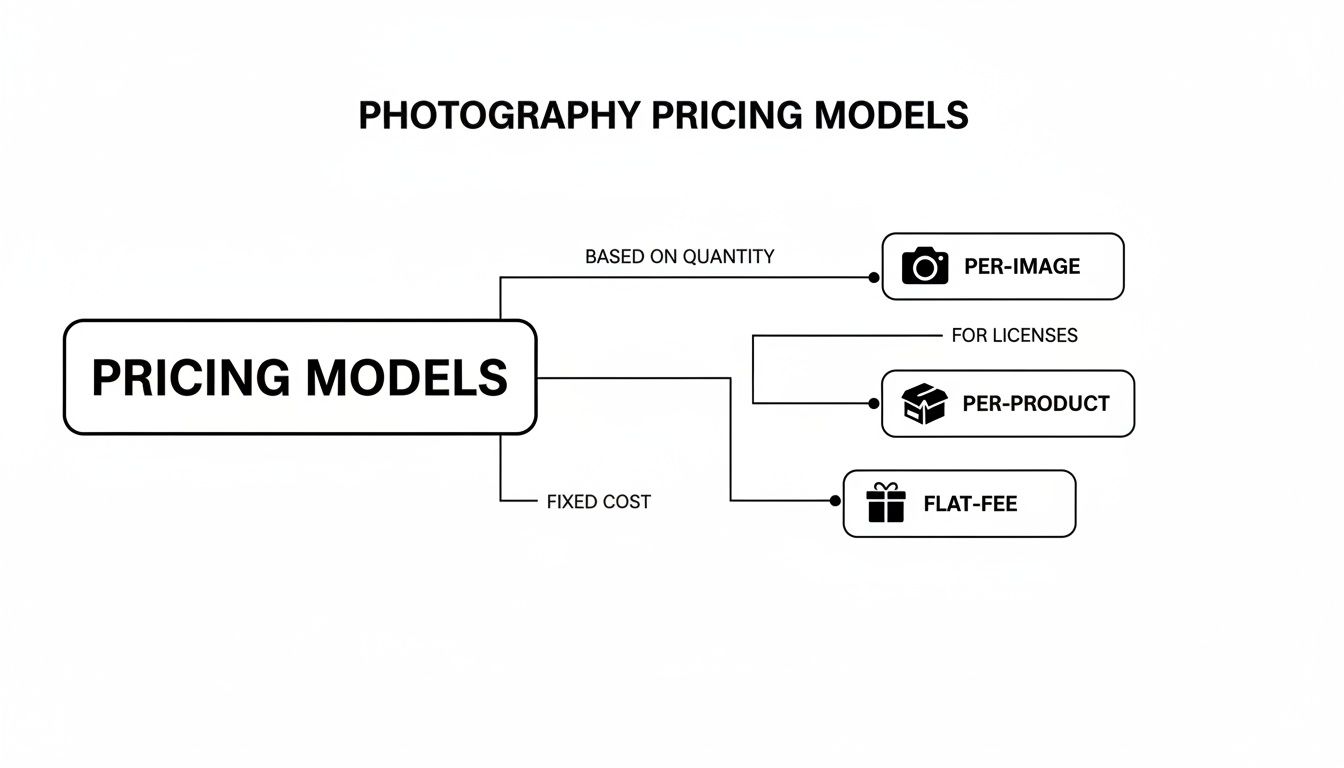
Flat-fee packages dominate for budget predictability, which is why they are standard for Amazon-focused services. But let's break down the specific inputs that determine the final price.
Factor 1: Product Preparation
This is the single most overlooked—and most expensive—mistake sellers make.
Sending a photographer a smudged, wrinkled, or scuffed product is an amateur move with professional-level costs. Every minute a photographer spends wiping fingerprints or a retoucher spends digitally fixing a scratch is time you are paying for, usually at a high hourly rate.
A photographer’s studio is not a repair shop. Every flaw on the product you send will be fixed in post-production, often at a rate of $50-$100+ per hour. Providing a perfect, retail-ready product is the easiest way to cut hundreds of dollars from your final bill.
Treat the products sent for photography as if they are being inspected by your most valuable retail buyer. Meticulous preparation isn't a suggestion; it's a direct cost-saving measure.
Factor 2: Styling and Staging Complexity
Styling is not about aesthetics. It is about visually communicating your product's value proposition and use case. The more complex the visual story, the higher the cost.
- Simple Styling: A basic flat lay or a clean shot with one or two simple props. Minimal setup time equals lower cost.
- Complex Styling: Building a custom set, sourcing specific props, or creating an entire scene from scratch. This requires significant time for planning, sourcing, and execution, which drives up the price.
Be ruthless about what you need. If a simple shot demonstrating a key feature will drive conversions, do not pay for an elaborate scene that adds aesthetic fluff but zero strategic value.
Factor 3: Lifestyle Production Value
Introducing models or unique locations elevates a photoshoot to a full production, and the costs scale exponentially.
- Models: Professional models involve agency fees, hourly rates, and usage rights negotiations. Costs can range from hundreds to thousands of dollars per day.
- Locations: Shooting outside a studio requires location scouting, permits, rental fees, and travel costs. A studio setup is always the most cost-effective option.
For Amazon, you can achieve a "lifestyle" feel without the massive production budget. A well-executed in-studio shot with a model demonstrating the product in use can be just as effective and significantly cheaper than a full on-location shoot. We break down more ways to balance cost and conversions over on our product photography blog.
Factor 4: Retouching Intensity
Post-production is where images are finalized, but it's also a major cost center. The level of digital manipulation required directly impacts your invoice.
- Basic Retouching: Standard color correction, dust removal, and background cleanup. This is almost always included in package pricing.
- Advanced Retouching: Compositing multiple images, significant reshaping (common for apparel), or removing complex reflections from glossy surfaces. This is specialized, time-consuming labor and is always billed accordingly.
This loops back to product preparation. A pristine product requires minimal retouching. The connection is direct and unavoidable.
Factor 5: Image Licensing and Usage Rights
This is the contractual detail that cripples uninformed brand owners. Who owns the final images and where you can use them is a critical cost factor often buried in legal jargon.
Traditional photographers often license images for specific uses (e.g., "web only") for a limited time. Using that same image in a PPC ad or on retail packaging could trigger a breach of contract and additional fees.
For any Amazon or e-commerce brand, the terms are non-negotiable: you require perpetual, worldwide, royalty-free usage rights for all online media. This ensures you can deploy your most valuable sales assets anywhere, forever, without future financial liability. E-commerce-focused photo services include this by default, but you must always verify it in the contract.
Calculating the True ROI of Your Amazon Images
Stop thinking about photography as an expense. It is a high-leverage investment in your primary conversion assets.
For an Amazon business, two metrics dictate profitability: Click-Through Rate (CTR) and Conversion Rate (CVR). Your images are the single most powerful lever you have to manipulate both.
Investing in strategic visuals isn't about making your listing "pretty." It is a financial calculation. Superior images improve the efficiency of your paid traffic, which directly lowers your Advertising Cost of Sale (ACoS). This isn't a creative decision—it's a P&L decision.

From Cost Center to Profit Multiplier
Too many sellers fixate on the upfront cost. They see a $400 invoice and perceive it as a sunk cost. This is a fundamental misunderstanding of Amazon's flywheel.
That one-time investment is a force multiplier. It works 24/7 to improve the efficiency of every dollar you spend on PPC and increase the profit of every organic sale. Your images are the first thing a shopper sees in search results and the primary tool they use to evaluate your product.
Better images mean more clicks and more conversions. Period.
The ROI Formula: A marginal lift in your conversion rate from superior images means you need fewer clicks to generate a sale. Needing fewer clicks directly lowers your ACoS. This isn't theoretical; it's the core mathematics of Amazon advertising.
Running the Numbers: A Practical Scenario
Assume you spend $2,000/month on PPC with a 40% ACoS, generating $5,000 in ad-driven sales. You invest $400 in a new, conversion-optimized image set.
Here's how that one-time cost pays for itself in perpetuity:
- Scenario A (Before): Your CVR is 10%. At $1.00 per click, you need 10 clicks ($10) to acquire one customer. Your ACoS is locked at 40%.
- Scenario B (After): Your new images, engineered from customer reviews and competitor analysis, lift your CVR to just 12%. Now, you only need approximately 8 clicks ($8) to acquire a customer.
- The Result: Your ad spend is now 20% more efficient. Your ACoS drops from 40% to 32%. The $400 investment saves you hundreds in wasted ad spend every month, adding thousands to your bottom line over a year.
This conservative model doesn't even account for the lift in organic sales from the improved CVR, which is pure profit.
Justifying the Investment with Data
The business case for high-quality images is data-driven. Professional-grade photos can boost conversion rates by up to 30%. With Amazon Sponsored Products CPCs averaging $0.81–$1.39, even a minor improvement in conversion efficiency has a massive financial impact.
A modest 10–20% reduction in your cost per acquisition means a $400–$1,000 photo investment can achieve positive ROI within weeks, not years.
This same ROI logic applies to video. It's worth exploring strategies for creating product videos that convert, as the initial investment follows the same principle: spend once to permanently lower customer acquisition costs. The math is direct and undeniable.
Comparing Traditional Photographers and Modern Image Services
The methodology for acquiring high-performance Amazon images has fundamentally changed. The legacy model of hiring a local freelance photographer—a generalist—is being replaced by specialized, productized services engineered for the brutal realities of e-commerce.
The choice is no longer about who has the best camera. For an Amazon operator, this decision directly impacts speed to market, budget predictability, and ultimately, conversion rate. A talented wedding photographer can take a beautiful picture, but they lack the deep understanding of buyer psychology required to make a customer click "Add to Cart" on a crowded search results page.
This isn't art; it's commerce. A modern image service begins with data—competitor weaknesses, review mining, and customer objections—to construct a visual sales argument, image by image.
Traditional Photographer vs Specialized Amazon Service
| Factor | Traditional Freelancer | Productized Service | Winner for Amazon Operators |
|---|---|---|---|
| Primary Goal | Create beautiful, artistic photos. | Increase sales and conversion rates. | Productized Service |
| Process | Creative briefs, mood boards, endless email chains. | Standardized, system-driven intake and production. | Productized Service |
| Turnaround Time | Weeks, often unpredictable. | Days, typically fixed (e.g., 72 hours). | Productized Service |
| Pricing | Hourly or day rates; unpredictable final cost. | Flat-fee packages; predictable and scalable. | Productized Service |
| Foundation | Artistic vision and style. | Market research and conversion data. | Productized Service |
| Amazon Expertise | Limited to none; generalist focus. | Deep understanding of Amazon's algorithm and buyer psychology. | Productized Service |
While a great freelancer has a role, the data is clear. For the specific goals of an Amazon seller—speed, predictability, and sales velocity—a specialized service is the superior tool.
Operational Speed and Scalability
Working with a traditional freelancer is a bespoke project, which means it is inherently slow. The process is bogged down by subjective mood boards, long email threads, and scheduling conflicts. A single project can easily stretch for weeks, creating a significant bottleneck that delays your launch.
Productized services operate like a factory for high-converting images. They use a streamlined, systemized process to deliver predictable results in days. This system is designed for scale. Whether launching one product or twenty, the process and timeline remain consistent.
The Amazon Reality: Speed is a competitive advantage. While your competitor is mired in a two-week email debate about lighting, a productized service can deliver a full, research-backed image set in 72 hours. You go live and start generating revenue while they are still in pre-production.
Strategic Focus and Conversion Expertise
This is the critical differentiator: a traditional photographer’s goal is to produce an aesthetically pleasing image. A specialized Amazon image service has one objective: increase your conversion rate.
This singular focus changes the entire workflow. A productized service doesn't start with a creative brief; it starts with research.
- Who are your top three competitors, and what are their visual liabilities?
- What objections are your target customers raising in their one-star reviews?
- What features do customers celebrate in five-star reviews?
- What questions are shoppers repeatedly asking in the Q&A section?
The answers to these questions become the blueprint for your image set. Each infographic, lifestyle shot, and comparison chart is engineered to resolve a specific doubt or answer a specific question. Your image block becomes a silent salesperson, preemptively crushing objections. Most traditional photographers are not equipped for this level of strategic analysis.
Cost Structure and Financial Predictability
This is where the models diverge most sharply. Modern, systematized image services offer significant cost advantages over the old-school freelance model. In fact, workflows leveraging new tools can be 60–80% cheaper than a manual photoshoot for a comparable set of images.
With modern services, you find flat-fee packages, like a $400 price for a complete seven-image Amazon set. This productized approach provides absolute cost certainty per listing. For a real-world example of this model, you can review Copycat247's pricing models.
For the vast majority of Amazon sellers, the decision is clear. A skilled local photographer is a tool for specific creative projects, but a specialized service that lives and breathes Amazon conversion provides a faster, more reliable, and ultimately more profitable path to market leadership.
Getting the Contract and Project Details Right
High-converting images can make a product launch. A poorly defined contract or mismanaged project can break it.
Too many operators get distracted by creative details and are subsequently burned by vague terms, surprise fees, or launch-killing delays buried in the agreement. The contract is not a formality; it is the primary tool for protecting your investment and ensuring the project aligns with your business objectives.
This isn't about legal minutiae. This is about ensuring you receive precisely what you paid for, on schedule.

The Non-Negotiables for Your Contract
Your contract must be simple, clear, and unambiguous. Before signing, confirm these four points are explicitly stated. Pushback on any of these is a major red flag.
- Usage Rights: You require perpetual, worldwide, royalty-free usage rights for all online and digital channels. Period. This ensures you can use your images on Amazon, your DTC site, in digital ads, and on social media forever, without incurring future licensing fees.
- Revision Policy: Vague promises of "unlimited revisions" often indicate a flawed workflow. A professional will define a specific number of revision rounds (typically one or two) included in the price and the cost for additional changes. This enforces clear communication and prevents endless feedback loops that kill timelines and budgets.
- File Delivery Specs: The contract must specify the exact deliverables. For Amazon, this means high-resolution JPEGs, at least 2000px on the longest side, in the sRGB color space. It should also define the delivery method and timing, such as via a shared cloud drive link.
- Turnaround Time: "ASAP" is not a deadline. The agreement must state a clear turnaround time in business days, beginning from the moment the photographer receives your product. For e-commerce-focused studios, a 2-3 business day turnaround is a reasonable benchmark.
How to Manage the Project to Prevent Failure
A strong contract is your defense, but flawless execution requires effective project management. Your responsibility is to make it as easy as possible for the photographer to succeed on the first attempt.
Your photographer is not a mind reader. The quality of your input—the strategic brief and the condition of the products you provide—directly determines the quality and speed of the output. A good brief is not micromanagement; it is a clear roadmap to the desired outcome.
Provide a simple, direct brief. Include links to your top three competitors, with concise notes on their visual weaknesses. List the key features and benefits your images must communicate. This research transforms your photographer from a service provider into a strategic partner.
Clarify communication protocols. Designate a single point of contact. And before shipping your products, inspect them meticulously. Every scratch you send becomes an avoidable cost and delay in post-production.
Finally, understand the revision process from the outset. Our own refund and revision policy provides a template for what a clear, professional process looks like. Clarity prevents conflict and ensures alignment from day one.
Your Images Are Your Most Valuable Sales Asset
On Amazon, your images are your entire sales force. They operate 24/7, engaging shoppers, answering questions, and closing sales. Every concept in this pricing guide is subordinate to that single reality.
Viewing photography as a creative line item is a strategic failure. It is a direct investment in your conversion rate—the most powerful lever you have for improving CTR, increasing CVR, and boosting the efficiency of your ad spend. Stop treating images as a box to be checked during a product launch.
Your competition already understands this. They are using their images to exploit the weaknesses in your listing, answer the questions you ignore, and build the trust you have failed to establish. Your photos are your primary weapon for reclaiming that ground.
Stop asking, "How much do photos cost?" Start asking, "What is the ROI of a high-converting image set?" The second question is how you build a profitable brand. It reframes a "cost" as a direct investment in sales velocity and market share.
Your Immediate Next Steps
This guide is a playbook, not a theoretical treatise. Use these frameworks to make an immediate, data-driven decision about your visual assets.
Here is your action plan:
- Audit Your Listings: Open your top competitor's listing in another tab. Compare your images side-by-side. Be brutally honest. Where are they communicating value more effectively? Where do their photos build more trust or better demonstrate the product?
- Calculate the Potential ROI: Use the formula from earlier. What would a 1-2% increase in your conversion rate translate to in monthly net profit? How many weeks would it take for a $400 investment in new images to pay for itself by lowering your ACoS?
- Invest Strategically: Make a decision based on the numbers. The single most important element of your Amazon presence demands a calculated investment, not an emotional one. Your brand’s growth depends on it.
Frequently Asked Questions
Product photography pricing should not be a mystery. Brand operators consistently face the same questions. Here are direct answers to help you make a faster, more profitable decision.
How Much Should I Budget for a New Amazon Product Launch?
For a competitive 7-image Amazon listing, budget between $400 and $1,200.
The lower end of that range, around $400, typically secures a flat-fee package from a specialized service, which includes the hero image, lifestyle shots, and infographics. For most operators, this is the most efficient and cost-effective path.
Attempting to assemble the same assets à la carte from a traditional photographer could easily exceed $1,000, as lifestyle shots alone often carry a premium. This is not an expense; it is a core investment in your launch. High-impact visuals from day one maximize the efficiency of your initial ad spend and drive the early sales velocity necessary for ranking.
Are Unlimited Revisions a Red Flag?
Yes, in most cases. "Unlimited revisions" sounds like a benefit but often signals a lack of upfront strategy.
A professional who conducts proper research—analyzing competitors and customer pain points—should deliver assets that are 90% correct on the first pass. A process that relies on endless back-and-forth indicates a broken or nonexistent strategy, which wastes your time and delays your launch.
An expert's process should be so refined that major revisions are rare. Look for a provider with a defined methodology and a contract that specifies one to two rounds of targeted revisions. This demonstrates confidence in their strategic approach.
What Are the Most Important Image Usage Rights?
This is the most critical detail in any photography agreement. It is non-negotiable.
You must secure "perpetual, worldwide, royalty-free" rights for all online and digital use. This specific legal language is your shield. It guarantees you can use your images on Amazon, your DTC website, social media, and in digital advertising campaigns forever, without any future financial liability.
Some photographers attempt to license images for a limited time or for specific platforms. This is a significant financial trap for any e-commerce brand and should be an immediate deal-breaker. If a quote's terms seem ambiguous, get in touch with our team for clarification. Securing the correct usage rights from the start protects your most valuable sales assets.
Ready to invest in Amazon listing images engineered to convert? ProductShots creates research-driven visual assets that answer customer questions and drive sales. Order your complete 7-image set for a flat $400 today.